

Agentic AI governance · 5 min read
How Auditors Check Access Decisions Made with AI
Auditors test AI access decisions like any other control: they sample completed decisions, ask who decided on what evidence, and try to re-perform the result. With Anugal, each AI recommendation is recorded with its reason next to the named reviewer's decision, so an AI access decisions audit has a record to test.
Picture the finance access review that everyone was dreading. Four hundred SAP users, two thousand lines of roles and permissions, and a deadline that lands in the middle of month-end close. Last quarter it dragged on for three weeks and ended with reviewers approving whatever was left on the final afternoon. This quarter the team switched on AI recommendations, and the campaign closed in a single day. The AI suggested “keep” on 95% of the lines, the reviewers agreed with almost all of them, and the Head of IAM sent a relieved note to the CISO.
Three months later the external auditor opens the file, looks at the completion dates, and asks one question: what exactly happened on that day?
That question is the whole of an AI access decisions audit, and this article explains how auditors answer it. They treat an AI-assisted review like any other control: they sample the completed decisions, ask who decided on what evidence, and try to re-perform the result. With Anugal, each AI recommendation is recorded with its reason next to the named reviewer's decision, so there is a record for the auditor to test rather than a completion rate to admire.
What does an AI access decisions audit check first?
Before the auditor samples a single line, they want two ratios. The agreement rate is the share of items where the reviewer followed the AI recommendation, and the override rate is the share where they did not. On their own, neither number proves anything. A 95% agreement rate can mean the AI is well tuned to your estate, or it can mean that nobody looked.
So the auditor splits the ratios by reviewer, by risk level and by time spent per decision, and the picture usually sharpens quickly. Zero overrides on privileged or SoD-sensitive items point to rubber-stamping, and so do hundreds of acceptances recorded in a few minutes. Regulators have already named this pattern. The EU AI Act requires that the people overseeing a high-risk AI system can “remain aware of the possible tendency of automatically relying or over-relying on the output” (Article 14(4)(b)). The habit is widespread: in ISACA's 2026 AI Pulse Poll of more than 3,400 respondents, only 36% said that humans approve most AI-generated actions before they execute, a finding about AI in general rather than access reviews in particular.
How do auditors sample AI-assisted access decisions?
Once the ratios have pointed them somewhere, auditors weight their sample toward high-risk access and toward accepted “keep” recommendations, because that is where a wrong decision does the most damage. The sampling itself runs in four steps.
- Select the sample:
First they confirm that the campaign covered every user in scope, and only then draw a sample that includes the overrides as well as the agreements. - Ask for the record behind each decision:
For each sampled line they ask for the record behind the decision, which goes beyond the usual certification evidence: the recommendation exactly as the reviewer saw it that day, the reason it gave, the data it drew on, and the reviewer's own decision and justification. - Check that disagreement was possible:
They check that reviewers could genuinely reject a recommendation, and whether anyone did so on a high-risk item. - Follow “remove” decisions through:
Finally they follow every removal through to the target system, because a revocation only counts once the access is gone.
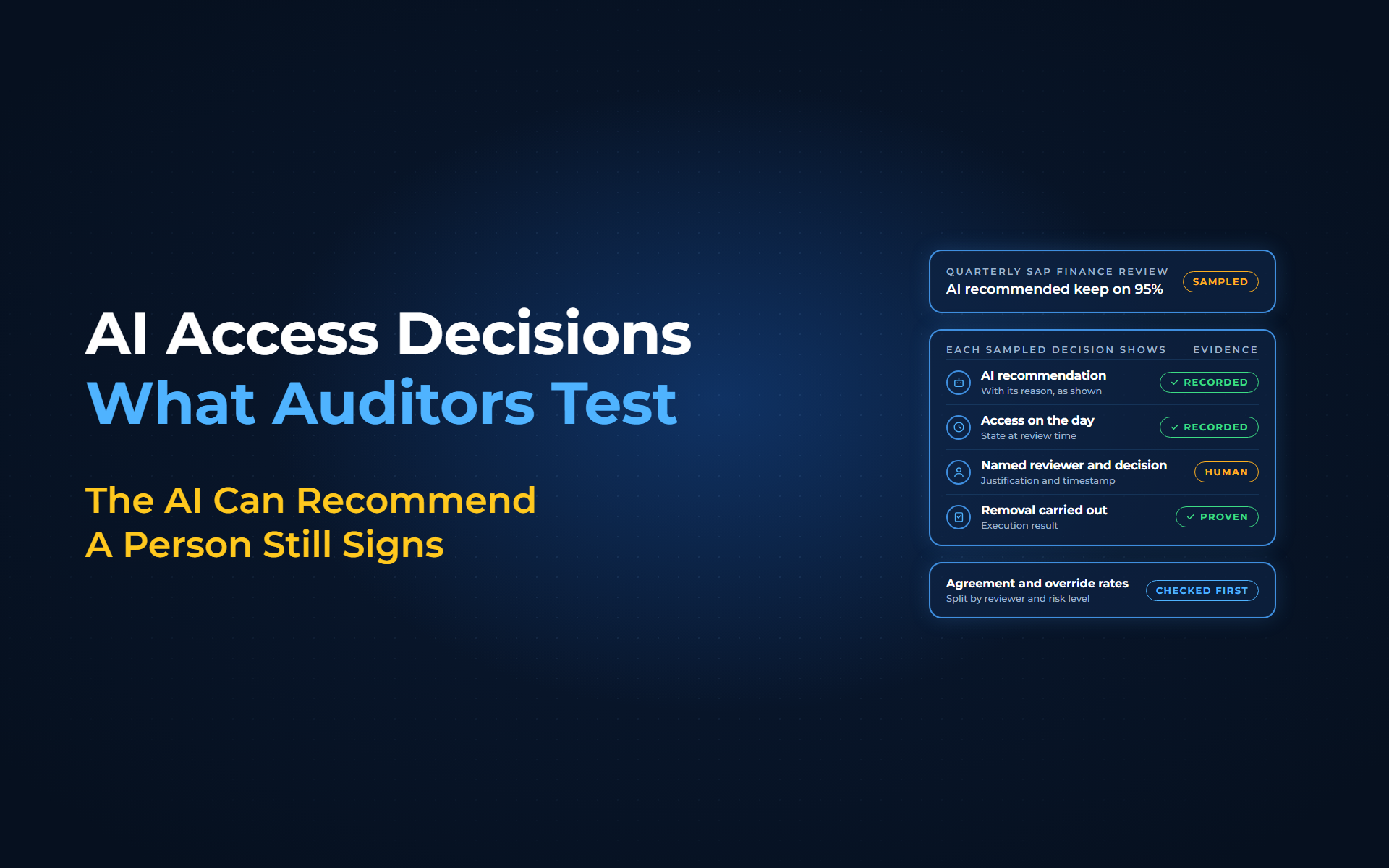
| Each sampled decision should show | Why the auditor asks |
|---|---|
| Recommendation and reason, as shown | Proves what the reviewer was told |
| Access state at review time | Judges the decision on that day's facts |
| Named reviewer, decision, justification, timestamp | Shows the right person decided, and how quickly |
| Execution result for removals | Proves the decision took effect |
Can an auditor re-perform an AI recommendation months later?
Only if the inputs were kept. ISA 500 describes re-performance as “the auditor's independent execution of procedures or controls that were originally performed as part of the entity's internal control”, and for an AI-assisted review that means re-making the reviewer's decision on the facts they had in front of them.
This is harder than it sounds, because access data changes every day and last quarter's role assignments have long since moved on unless the review captured them. The model may have moved on too: if it learns from later decisions, asking it the same question today can produce a different answer. The workable test is therefore reconstruction rather than regeneration. The auditor asks to see the recorded data snapshot, the recommendation and its reason, and checks that the three agree with each other and with the reviewer's decision. The EU AI Act points the same way when it expects high-risk systems to “technically allow for the automatic recording of events (logs)” (Article 12(1)).
Who is accountable for the AI step?
The reviewer owns every decision they sign, and no recommendation changes that. What the AI step adds is a second layer of ownership that most companies have not yet named: someone who owns the recommendation logic, someone who approved its use and its settings, and someone who reads the override pattern after each campaign and asks what it says about the model.
Supervisors are starting to ask for exactly this. APRA's AI letter of 30 April 2026 expects “human involvement for high-risk decisions” and notes, with some understatement, that “identity and access management capabilities have not yet adjusted to nonhuman actors such as AI agents.” The EU AI Act asks that overseers can “disregard, override or reverse the output” (Article 14(4)(d)), and for Annex III high-risk systems that duty applies from 2 December 2027 under Regulation (EU) 2026/1744. Whether a particular access-review tool falls inside that scope is a question for your lawyers. The auditor's test is simpler, and it is the same test they have always applied.
The AI can recommend. A person still signs.
Where Anugal fits
With Anugal, AI recommends and people decide, and Anugal never uses AI to approve or revoke access. For every line in a campaign, the AI-based access recommendations suggest retain, remove or review carefully, each with a short explanation the reviewer can read before they act. From there, the record the auditor will later ask for builds itself.
- The recommendation and its reason are kept:
Every recommendation is recorded alongside the reviewer's decision, their rationale and the execution outcome, so the day's facts are never reconstructed from memory. - A named person makes the final decision:
Reviewers keep full authority to override, and no decision is taken without human confirmation. In access certifications, a justification is required for approvals, rejections and exceptions alike. - Approval cannot override a policy violation:
Policies stay enforced even when a reviewer says yes, and genuinely urgent, time-bound needs go through governed emergency (firefighter) access instead. - The record matches the access state at review time:
Grants, approvals, removals and certifications become append-only audit records linked to the access state as it stood when the review happened. - Rubber-stamping shows up in the data:
Anugal flags unusual approval activity, and agreement and override rates can be calculated straight from the recorded decisions.
Anugal helps support audit-ready evidence, while the acceptable agreement rate and the sampling method remain decisions for your audit team.
Before your next AI-assisted campaign
Give the auditor a record, not a completion rate
Back to that one-day campaign. Closing fast is good news only if every one of those two thousand decisions traces back to a person, a reason and the facts as they stood that morning. If your next review will lean on AI recommendations, let's walk through what your auditors are going to sample, or email info.anugal@businesscoresolutions.com.
AI access decisions audit: common questions
What does an AI access decisions audit test?
Who made each final decision, what the AI recommended and why, the access data it used, and whether the reviewer could and did override it. Start with agreement and override rates, then sample individual decisions.
Is a high agreement rate with AI recommendations a red flag?
Not on its own. In an AI-assisted access review audit, it can mean the AI is well tuned or that reviewers accepted without looking. Break the rate down by reviewer, risk level and time per decision before drawing a conclusion.
Can an auditor re-perform an AI recommendation months later?
Only if the inputs were kept. Access data changes daily, and a model that learns from later decisions may answer differently today. The workable test is to reconstruct the recorded data snapshot, recommendation and reason, and confirm they are consistent.
Who is accountable when a reviewer follows a wrong AI recommendation?
The reviewer who signed the decision. The AI step also needs an owner for its logic, someone who approved its use and settings, and someone who reviews the override pattern after each campaign.
Does the EU AI Act require human oversight of access-review AI?
Article 14 sets human oversight duties for high-risk AI systems, including the ability to override the output and awareness of automation bias. Annex III obligations apply from 2 December 2027. Whether a given access-review tool is in scope is a legal question, but Article 14 is a sensible bar either way.
Sources
- Regulation (EU) 2024/1689 (EU AI Act), Articles 12 and 14, EUR-Lex (https://eur-lex.europa.eu/legal-content/EN/TXT/HTML/?uri=CELEX:32024R1689). Article 12(1) automatic recording of events (logs); Article 14(1), 14(4)(b) automation bias and 14(4)(d) disregard, override or reverse the output.
- Regulation (EU) 2026/1744 of 8 July 2026 (Digital Omnibus on AI), amending Regulation (EU) 2024/1689, Official Journal, 24 July 2026 (http://data.europa.eu/eli/reg/2026/1744/oj). Article 113, third paragraph, point (c) as amended: Chapter III, Sections 1 to 3 (including Articles 12 and 14) apply from 2 December 2027 to high-risk AI systems under Article 6(2) and Annex III.
- APRA, Letter to industry on artificial intelligence (AI), 30 April 2026 (https://www.apra.gov.au/apra-letter-to-industry-on-artificial-intelligence-ai). Human involvement for high-risk decisions and accountability; identity and access management not yet adjusted to nonhuman actors.
- ISACA, 2026 AI Pulse Poll results, ISACA Now blog, 23 March 2026 (https://www.isaca.org/resources/news-and-trends/isaca-now-blog/2026/ai-pulse-poll-reveals-rampant-uncertainty-on-enterprise-landscape). More than 3,400 respondents; 36% say humans approve most AI-generated actions before execution.
- ISA (Ireland) 500, Audit Evidence, updated October 2022, paragraph A24, IAASA (https://iaasa.ie/wp-content/uploads/2022/11/ISA-500_Oct_2022.pdf). Definition of reperformance.
- Anugal: AI-Based Access Recommendations (https://anugal.ai/ai-based-access-recommendations/).
- Anugal: Access Certifications (https://anugal.ai/access-certifications/).
- Anugal: Reports and Audit Trails (https://anugal.ai/reports-audit-trails/).
- Anugal: Anugal.AI (Agentic Architecture) (https://anugal.ai/anugal-ai-agentic-architecture/). Governance policies remain enforced and cannot be overridden.
- Anugal: Why Access Reviews Get Rubber-Stamped (and the Fix) (https://anugal.ai/access-review-rubber-stamping/). Related post.
- Anugal: Audit-Ready Access Certification: Evidence in One Click (https://anugal.ai/access-certification-audit-evidence/). Related post.