

ANUGAL UAC SERIES · 5 OF 6 · AGENTIC AI
Agentic AI Access Reviews: Advisory, Assisted, Controlled
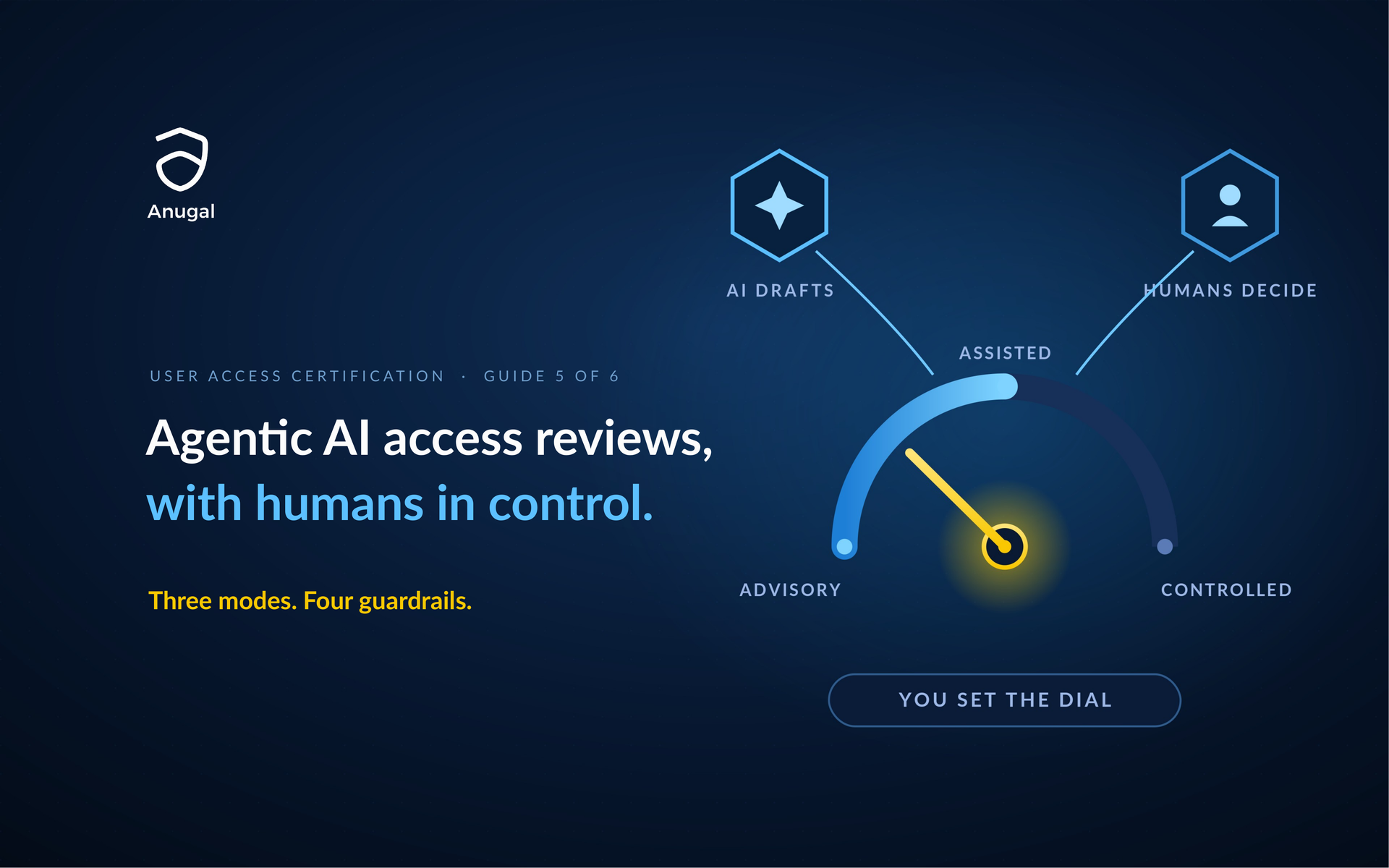
The board asks one question about AI in access reviews: what exactly is it allowed to do? The honest answer is a spectrum, not a yes or no. On one end, AI recommends and a human decides. On the other, pre-approved policy executes and every action leaves a trail. The distance between the two is governance, written down.
THE SHORT ANSWER
Agentic AI in access certification means persistent, policy-bound agents that analyze identity signals and support reviewers without bypassing human accountability. Three operating modes cover the spectrum: Advisory generates recommendations, Assisted pre-validates with one-click human approval, and Controlled Automation executes under pre-approved policy with a full evidence trail.
What does agentic mean here?
Not a chatbot bolted onto a dashboard. Agentic means persistent, policy-bound agents living inside the certification workflow, continuously analyzing identity signals: peer-group comparison, role usage patterns, risk posture, dormant and overlapping access, and segregation-of-duties conflicts, surfaced in the review where the decision happens.
The distinction that matters to a board sits one level up: agents recommend, prioritize, and assist. Final authority stays with accountable owners, exactly as your control framework already requires.
The question is never whether AI decides; it is which written policy the decision runs under.
The three operating modes
Anugal's UAC materials define the spectrum in three modes, and the discipline is choosing per decision type, not per platform.
| Mode | What it does | Example in certification |
|---|---|---|
| Advisory | Generates context-aware recommendations from access history, risk posture, and policy rules | Surfaces high-risk access and suggests certify or revoke decisions |
| Assisted | Pre-validates access against SoD policies and risk libraries, with one-click execution on reviewer approval | Reviewer accepts an AI recommendation and the decision applies |
| Controlled Automation | Pre-approved policies govern automated actions with a full evidence trail | Certification enforcement and deprovisioning execute automatically under policy |
Autonomy is a dial you set per decision type, not a switch you flip for the platform.
The four guardrails that make it auditable
- Policy-first by design. Agents operate strictly within defined governance rules, SoD policies, and approval models. No policy, no action.
- Human accountability preserved. Agents recommend, prioritize, and assist; final authority remains with accountable owners wherever policy says a human decides.
- Explainable and auditable. Every agent insight, recommendation, and action is traceable with full context, and overrides log alongside the rationale.
- Orchestration, not chaos. Agents execute through existing workflows, with no side channels and no shadow logic an auditor cannot follow.
If the AI cannot show its reasoning to an auditor, it does not belong in the control.
What changes for reviewers
Governance is the frame; the day-to-day change is workload. Per Anugal's UAC materials, stated as our claims: plain-language rationale cuts interpretation time 60 to 70 percent by translating entitlements and transaction codes into approve, revoke, or justify guidance. Risk filtering and policy-based auto-approval reduce approval volume 20 to 30 percent. Contextual AI summaries lift review efficiency 40 to 50 percent by ending manual lookups across SAP, AD, and HR. And the whole flow reaches reviewers inside Microsoft Teams: a conversational alert with a prioritized queue, signals surfaced with context, and one-tap approve, reject, or complete.
The Agentic Governance Checklist: 4 questions before AI touches access
THE AGENTIC GOVERNANCE CHECKLIST
- Which written policy bounds the agent, and who owns that policy?
- Who is the accountable human for each decision type, by name?
- Where does the agent's reasoning get logged, and who reviews overrides?
- Does every agent action run through existing workflows, with no side channel?
Mistakes that turn AI into a finding
- Automating before writing the policy. Controlled Automation without a pre-approved policy is unsupervised change to access, which is the definition of a deficiency.
- Treating a recommendation as a decision. Skipping the accountable owner in Advisory or Assisted mode quietly promotes the agent past its mandate.
- Logging outcomes but not rationale. An auditor asks why the access was certified, not only that it was. Keep the reasoning.
Frequently asked questions
Does AI replace access reviewers?
No. In Advisory and Assisted modes the human decides, better informed and faster. Controlled Automation applies only where pre-approved policy governs the action, with full evidence. The reviewer's job shifts from clearing rows to judging exceptions, which is the part worth a human.
What is controlled automation?
The mode where pre-approved policies govern automated actions end to end, including certification enforcement and deprovisioning, with a complete evidence trail. It suits decision types your organization has already standardized, and it stays inside the same workflows auditors already test.
Are AI-assisted certifications auditable?
Yes, when explainability is built in: every insight, recommendation, decision, and override traceable with context and timestamps. Done this way, AI strengthens the audit position, because the rationale behind each decision exists in writing instead of in a reviewer's memory.
How Anugal solves it
The modes and guardrails above are Anugal's own architecture, shipped, not aspirational.
HOW ANUGAL SOLVES IT
- Anugal AI Agent, in three modes. Advisory, Assisted, and Controlled Automation, set per decision type under written policy.
- Signals, not noise. Peer-group comparison, usage patterns, dormant and excess detection, and SoD awareness inside every review screen.
- Plain-language everything. Rationale that turns entitlements and transaction codes into business-readable guidance (interpretation time down 60 to 70 percent, vendor claim).
- Teams-native agentic reviews. Prioritized queue, insights inline, one-tap approve, reject, or complete, on mobile.
- A trail auditors follow. Every recommendation, decision, override, and automated action logged with context.
Start in Advisory mode and earn your way to Controlled Automation on your own evidence. That path is the honest one, and it is how we run pilots.
About Anugal. Anugal is the Agentic Identity Governance and Administration platform from Business Core Solutions (BCS). It orchestrates identity lifecycle, access requests, certifications, and risk governance across the enterprise, with 350+ integrations through SCIM 2.0, REST APIs, OData, SOAP, SAP ABAP, and SQL.
SEE IT ON YOUR OWN CAMPAIGN DATA
Bring one recent certification export and we will show you what Anugal UAC surfaces in it: the risk, the rubber-stamps, and the revocations that never executed.
hello@businesscoresolutions.com
Next in this series is live: Access Certification Audit Evidence: Ready in One Click