

ANUGAL UAC SERIES · 6 OF 6 · AUDIT
Audit-Ready Access Certification: Evidence in One Click
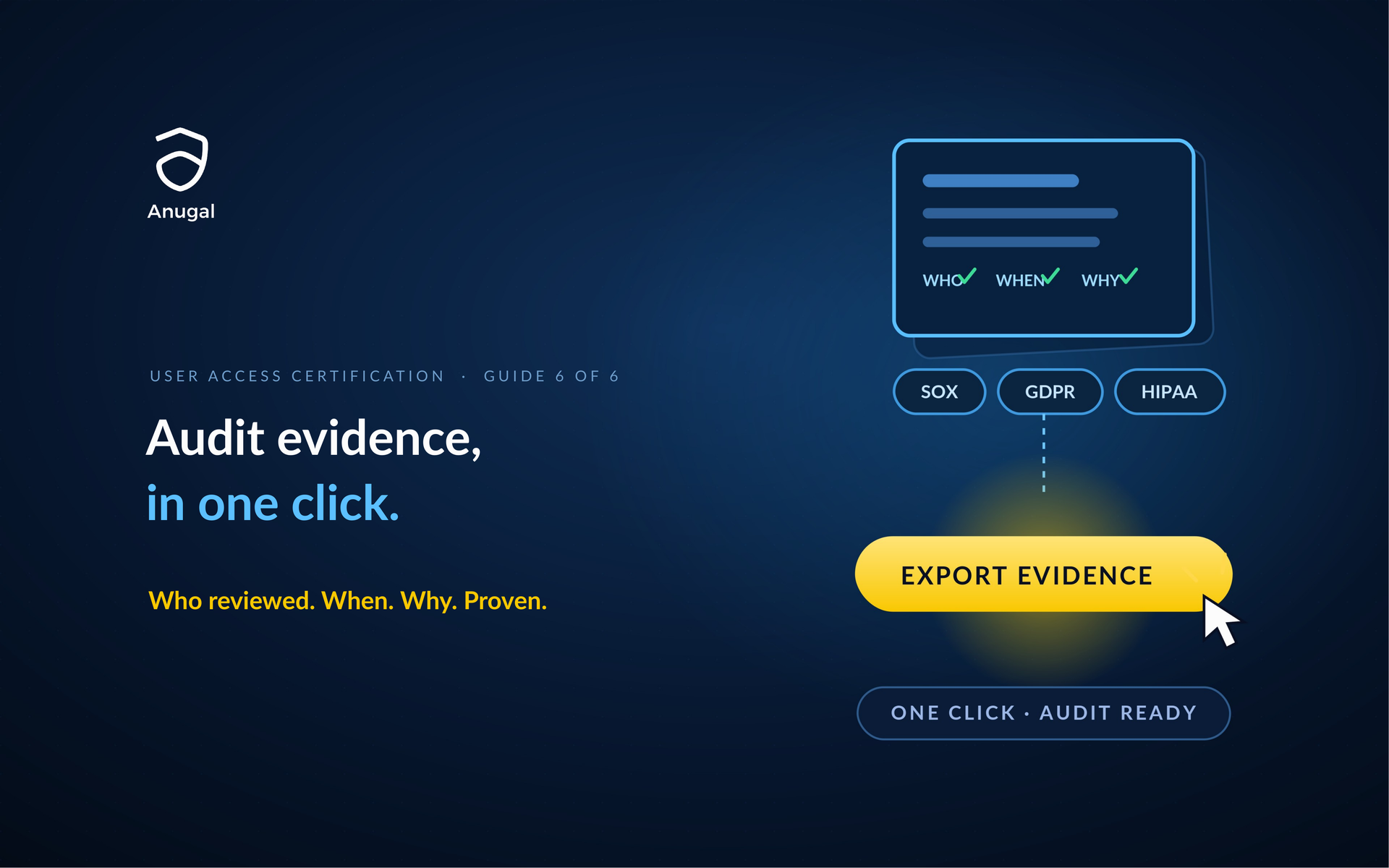
The auditor's request looks small: show the access review evidence for the finance systems, including who decided, when, why, and what happened to the revokes. In most enterprises that sentence launches two weeks of screenshots, exports, and email archaeology. In a governed platform, it is one click.
THE SHORT ANSWER
Audit-ready access certification evidence means every review decision logged with timestamp, reviewer, and rationale; proof that revocations executed; completeness across the campaign; and tamper-evident storage, produced on demand. Evidence generated continuously as a by-product of the workflow replaces the after-the-fact reconstruction that creates findings.
What do auditors ask for?
Seven artifacts cover nearly every request: the campaign population and how it was scoped, reviewer assignments and their independence, each decision with its timestamp and rationale, proof that revocations executed, exception and escalation records, the recurring schedule showing the control operates continuously, and IPE, meaning information produced by the entity, with its integrity demonstrable.
The expectation spans frameworks: governed certification supports compliance programs across SOX, GDPR, HIPAA, PCI-DSS, NIS2, GxP, and RBI mandates. And audit practitioners keep tracing ITGC findings to the same root: undocumented access reviews and missing evidence.
Auditors do not test whether you reviewed; they test whether you prove how.
Why does after-the-fact evidence fail?
Because reconstruction is a memory exercise performed under deadline. Decisions live across spreadsheets, inboxes, tickets, and screenshots; versions disagree; the person who ran the Q1 campaign left in Q3. Whatever survives assembly still faces the integrity question: what stops a cell edited in October from claiming an April decision?
The exposure is not theoretical. With 90 percent of large organizations reporting an identity-related incident in the past year per the IDSA's 2024 study, the same evidence that satisfies an auditor is what an incident response team reaches for first.
Evidence assembled before the audit is a project; evidence generated during the review is a property.
What does continuous evidence look like?
- Every decision logs itself. Timestamp, reviewer, and rationale captured at the moment of decision, for every user in every campaign.
- AI reasoning logs too. Each recommendation, its rationale, and every human override lands in the same trail, so assisted decisions stay explainable.
- Storage is tamper-evident. The audit store demonstrates integrity, answering the October-edit question before it gets asked.
- Enforcement is part of the record. Deprovisioning execution links to the decision that caused it, closing the loop auditors sample.
- IPE is one click. System-generated evidence packs and continuous compliance reports for SOX and internal audit, produced on demand.
The Audit Evidence Checklist: 6 artifacts on demand
THE AUDIT EVIDENCE CHECKLIST
- Campaign population and scope definition, with the risk-tier logic.
- Reviewer assignments demonstrating ownership and independence.
- Every decision with timestamp, reviewer, and rationale.
- Revocation execution proof linked to each revoke decision.
- Exception and escalation records with owners and dates.
- System-generated IPE with demonstrable integrity.
Mistakes that create findings
- Assembling evidence at audit season. Reconstruction is where the gaps, versions, and doubts come from.
- Storing decisions in email. An inbox is not a system of record, and legal holds are not an evidence strategy.
- Proving decisions but not enforcement. A documented revoke with a live account is a finding with your signature on it.
Frequently asked questions
What is IPE in an audit?
Information produced by the entity: reports and data your own systems generate as audit evidence. Auditors test its completeness and accuracy, so IPE needs demonstrable integrity, ideally system-generated from a tamper-evident store rather than assembled by hand in a spreadsheet.
What evidence do auditors expect for access reviews?
Population and scope, reviewer assignments, every decision with timestamp and rationale, proof revocations executed, exception handling, and the recurring schedule. The stronger programs produce all of it on demand because the workflow generated it continuously.
Does AI-assisted review complicate audits?
Not when reasoning is logged. If every recommendation, decision, and override carries traceable context, AI strengthens the audit position: the rationale exists in writing at the moment of decision instead of being reconstructed from memory months later.
How Anugal solves it
Anugal UAC treats evidence as a property of the workflow, which is exactly what this series has argued from post one.
HOW ANUGAL SOLVES IT
- Full log coverage. Every event, every user, every decision: certifications, AI rationale, and overrides logged automatically (per Anugal's UAC materials).
- Tamper-evident audit store. Integrity is demonstrable, so the evidence answers the hard question before the auditor asks it.
- One-click IPE. System-generated evidence packs and continuous compliance reports for SOX and internal audit.
- Enforcement in the record. Deprovisioning execution links to the decisions that caused it, closing the sample loop.
- Framework coverage. Supports compliance programs across SOX, GDPR, HIPAA, PCI-DSS, NIS2, GxP, and RBI mandates.
About Anugal. Anugal is the Agentic Identity Governance and Administration platform from Business Core Solutions (BCS). It orchestrates identity lifecycle, access requests, certifications, and risk governance across the enterprise, with 350+ integrations through SCIM 2.0, REST APIs, OData, SOAP, SAP ABAP, and SQL.
SEE IT ON YOUR OWN CAMPAIGN DATA
Bring one recent certification export and we will show you what Anugal UAC surfaces in it: the risk, the rubber-stamps, and the revocations that never executed.
That completes the series. Start from Blog 1: What Is User Access Certification? or share the video with your review team.