

SAP IDM END-OF-LIFE SERIES · 1 OF 3 · PILLAR
SAP IDM End of Life 2027: What It Means and Why to Act Now
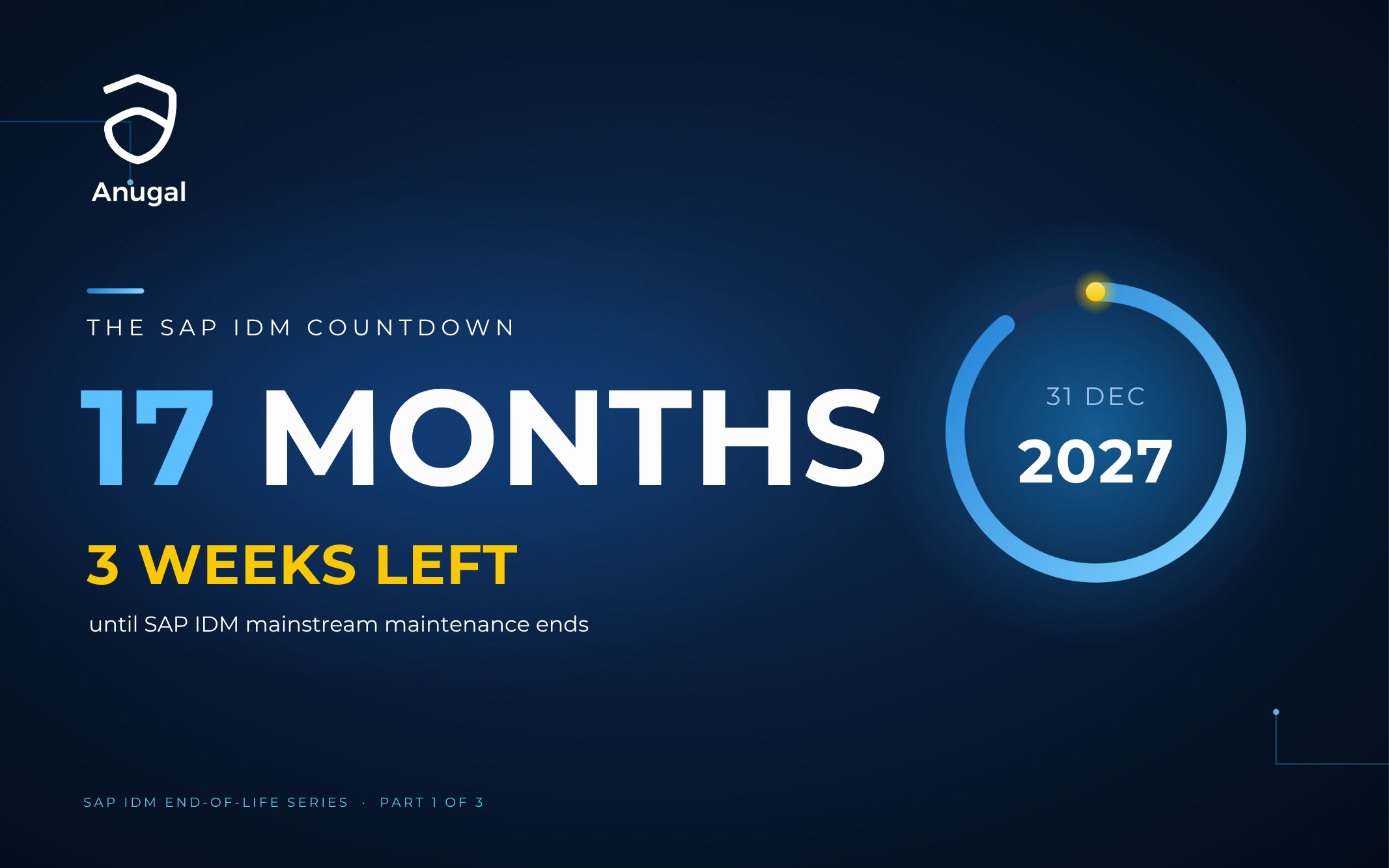
On 31 December 2027, SAP ends mainstream maintenance for SAP Identity Management. That is 17 months and 3 weeks from today. A typical replacement takes 18 to 36 months.
Here is what it means, what waiting costs, and what to do next. Plain language, one real-world picture, one checklist.
THE SHORT ANSWER
SAP IDM end of life means SAP stops mainstream maintenance for SAP Identity Management on 31 December 2027: no more security patches, fixes, or compliance updates. Paid extended maintenance runs to 2030. There is no successor product. SAP IDM keeps running after 2027, unsupported, while your risk grows.
What happens on 31 December 2027
Picture your first identity audit of 2028. The auditor asks one routine question: is the system that grants access to your financials still supported by its vendor? For SAP IDM customers, the honest answer that morning is no.
Mainstream maintenance is SAP's promise to keep a product safe: security patches, bug fixes, compliance updates, standard support. SAP announced in 2023 that this promise ends for SAP IDM on 31 December 2027. A one-time paid extension moves the safety net to 2030. Then it is gone.
Two facts make this bigger than a normal upgrade cycle. There is no SAP successor for IDM 8. And SAP points customers toward Microsoft Entra ID instead, under a partnership with Microsoft announced in February 2024.
Here is the trap. Nothing switches off on 1 January 2028. Provisioning runs. Password resets work. The dashboard stays green. But auditors do not ask whether your identity system runs; they ask whether it is supported. And from that day, every new vulnerability stays unpatched, forever.
On 1 January 2028, SAP IDM does not stop working; it stops being defensible.
What this looks like in real life
Picture a mid-size manufacturer. SAP ECC at the core, SuccessFactors for HR, 40-plus other applications, 5,000 employees and contractors. SAP IDM has quietly handled joiners, movers, and leavers for a decade, running on custom scripts nobody has touched since their author left.
2026 passes in meetings. In 2027 the team requests extended-maintenance pricing and starts a rushed vendor selection, alongside every other IDM customer doing the same. The project starts late, so the team rebuilds the old scripts as-is instead of cleaning them up. The first audit of 2028 lands mid-migration, and the finding writes itself: unsupported software operating the company's access controls.
Nothing in that story is exotic. It is the default outcome of deciding late, and every step of it is avoidable. The avoiding starts this year.
What waiting costs
The cost of staying is not one line item; it is six risks on the same calendar.
| What changes | What it means for you | Who owns it |
|---|---|---|
| No more security patches | Your identity system becomes a permanent soft spot; every new flaw stays open | CISO |
| Unsupported software in audit scope | Likely findings in SOX and ISO 27001 testing | Risk and Compliance |
| Old connectors, moving targets | Connected apps keep updating, integrations break, manual work returns | Head of IAM |
| Shrinking skills pool | Fewer people know SAP IDM each year, and they cost more | CIO |
| Extended maintenance fee | Money spent on a product receiving nothing new | CFO |
| Migration forced into 2027 | Rushed timeline, premium rates, weak negotiating position | CIO |
Delay removes nothing from this table. It removes slack.
Three deadlines, one date
2027 is not one deadline for SAP customers. It is three.
- SAP Identity Management: mainstream maintenance ends 31 December 2027; paid extension to 2030.
- SAP ECC and Business Suite 7 (enhancement packages 6 to 8): mainstream maintenance ends 31 December 2027; extended maintenance to 2030 at a two-percentage-point premium. Older packages already fell out of maintenance in 2025.
- SAP Access Control 12.0: mainstream maintenance ends 31 December 2027, with extended support to 2030.
Underneath sits a platform reason: SAP IDM runs on SAP NetWeaver Java, which SAP is phasing out by 2030. This retirement is structural. Plan for no reprieve.
Your identity tool, your ERP core, and your GRC stack all age out inside the same window. The same architects, the same budget cycle, the same 18 months.
Is extended maintenance to 2030 a real option?
Yes, as a bridge. No, as a plan.
Analyst firm KuppingerCole notes the premium sits only slightly above the regular fee, and still calls the runway too short for an IGA transition to wait. The fee buys patches and time. It buys no features, no successor, and no smaller migration: the work waiting in 2029 is the same work waiting today, at 2029 prices.
Extended maintenance buys time; it does not buy a plan.
The math nobody wants to do
Work backward from 31 December 2027. An estate inventory. Vendor selection and contracting. Implementation and workflow migration, the long pole. A parallel run until old and new outputs match. Then a buffer, because practitioner guidance says finish six months early so one full audit cycle runs on the new platform.
Add the stages and published guidance lands between 18 and 36 months end to end. You have 17 months and 3 weeks.
The window is now shorter than the migration.
That is subtraction, not a scare tactic. The version of this project with slack in it expired. Four paths remain:
- Run unsupported. A timing gamble, never a destination.
- Buy extended maintenance to 2030. A fair bridge for a program already moving; an expensive pause button otherwise.
- Follow SAP's pointer to Microsoft Entra ID. Right for some Microsoft-centric, cloud-first estates. Thin where you need non-SAP depth, custom workflows, on-premise coverage, or fine-grained segregation of duties. Part 2 of this series compares the two honestly. Await Part 2: Your SAP IDM Options: Microsoft Entra vs a Full IGA Platform.
- Move to a full IGA platform covering SAP and non-SAP. Built for mixed estates that need governance depth.
Where Anugal fits
Anugal sits in that fourth category. This is the one place in this guide where we talk about our own platform, so judge it with the same checklist you apply to everyone else.
What Anugal does for an SAP IDM exit, in plain terms:
- Your SAP estate keeps working. Bi-directional adaptors for SAP ECC, S/4HANA, SuccessFactors, BTP, and SAP GRC carry provisioning through the transition, with pre-built connectors covering the non-SAP estate.
- Your master data moves with you. Anugal's migration service carries identity master data out of SAP IDM: users, roles, assignments, and entitlements land in the new platform, so you start from your data, not from a blank sheet.
- Compliance sits in the core, not in a report. Segregation-of-duties checks run at request time, before access lands. Auditors get evidence, not explanations.
- The exit is phased, not a leap. Per Anugal's published methodology, the platform deploys with core connectors in 6 to 8 weeks; workflows migrate next; then both systems run in parallel until outputs match, so your audit evidence survives the move. The full technical program models out near six to nine months.
- It runs at real-world scale. Coromandel International manages 5,000+ identities across 40+ applications via Anugal.
Notice the two clocks. Industry guidance says 18 to 36 months for the whole program, and most of it is deciding: selection, contracting, readiness. The platform work is the smaller share. The technology takes months; the deciding is what takes years. Start the deciding now and the deadline stops being scary.
One honest note: if your estate is genuinely Microsoft-centric, cloud-first, and light on non-SAP governance needs, Entra might be your right answer. Part 2 helps you choose without a pitch.
The SAP IDM Countdown Checklist: 10 moves for Q3 2026
You do not need a vendor decision this quarter; you need an estate you can describe.
THE SAP IDM COUNTDOWN CHECKLIST
- Put both dates in the risk register, each with a named owner: 31 December 2027 and 2030.
- Confirm your extended-maintenance price with SAP, in writing.
- List everything SAP IDM touches: targets, jobs, custom workflows, password hooks.
- Count identities and connected systems; split SAP from non-SAP.
- Map where SAP Access Control rules meet IDM provisioning.
- Circle your first identity audit after 1 January 2028. That is the real deadline.
- Write evaluation criteria before you watch a single demo.
- Pick the category before the vendor: Entra-centered or full IGA. Await Part 2: Your SAP IDM Options: Microsoft Entra vs a Full IGA Platform.
- Back-plan from 31 December 2027 and mark the last responsible start date. Await Part 3: SAP IDM Migration Guide.
- Score your readiness in writing this quarter, so 2027 starts from evidence.
Mistakes that stall SAP IDM decisions
- Treating 2027 as a soft date. The one extension already exists: to 2030, at a stated premium, once.
- Buying extended maintenance instead of a plan. Programs anchored on 2030 tend to start in 2029.
- Demoing vendors before inventorying the estate. You buy the storyline, then meet your custom workflows in month nine.
- Leaving audit evidence for cutover weekend. Evidence has to survive the move, not restart after it.
Frequently asked questions
When does SAP IDM support end?
Mainstream maintenance for SAP Identity Management ends on 31 December 2027. A one-time paid extension runs until 2030. After that, SAP ships no new security patches, fixes, or compliance updates for the product. SAP announced the retirement in 2023.
Is there a successor product for SAP IDM?
No. SAP names no like-for-like successor for SAP IDM 8. SAP points customers toward Microsoft Entra ID under a joint collaboration with Microsoft, and positions SAP Cloud Identity Services for the SAP ecosystem. Neither is a drop-in replacement covering non-SAP systems.
How long does an SAP IDM migration take?
Plan for 18 to 36 months end to end, most of it selection, contracting, and readiness rather than technology. Practitioner guidance recommends finishing about six months before the deadline, so one full audit cycle runs on the new platform before support ends.
What happens if we keep running SAP IDM unsupported?
It keeps running while risk compounds: no patches for new vulnerabilities, likely audit findings for unsupported software inside identity controls, breaking integrations as connected systems update, and a shrinking pool of people who know the product. The longer the wait, the more expensive the exit.
SEE WHERE YOU STAND
Your deadline is fixed. Your readiness is measurable. Take the SAP IDM Readiness Assessment: 15 questions, a scored result, no call required.
Take the SAP IDM Readiness Assessment → anugal.ai/sap-idm-readiness
Questions first? Write to hello@businesscoresolutions.com
Await Part 2: Your SAP IDM Options: Microsoft Entra vs a Full IGA Platform.
Frequently Asked Questions
What is privilege drift in complex role models?
Privilege drift is the gradual divergence between the access a user should hold and the access they effectively hold, driven by structural weaknesses in role models such as Cartesian role multiplication, inheritance opacity, exception-to-permanence drift, and integration-edge inconsistency.
How is privilege drift different from privilege creep?
Privilege creep describes an individual user accumulating permissions over time. Privilege drift describes the structural divergence between intended and effective access across the role model itself. Privilege creep is the symptom and privilege drift is the cause.
Why does privilege drift cause audit findings?
Privilege drift produces stale entitlements, segregation of duties violations, orphaned accounts, and undocumented exceptions. These map directly to audit findings under NIST SP 800-53 AC-6, SOX Section 404, SOC 2, ISO 27001, and HIPAA access control requirements.
How do you detect privilege drift in a complex environment?
Detection requires continuous access intelligence, peer-baseline outlier comparison, and usage-aware analysis across all governed applications. Point-in-time certification cycles cannot detect drift because the access landscape changes between reviews.
How does Anugal contain privilege drift continuously?
Anugal applies real-time access intelligence, AI-powered role mining, segregation of duties enforcement, and usage-aware certification across hybrid environments including long-tail applications, and reports 70 to 80% lower manual certification effort and 50 to 70% fewer audit findings on access reviews.