

SAP GRC Transition · 8 min read
Which Process to Move First in an SAP GRC Transition
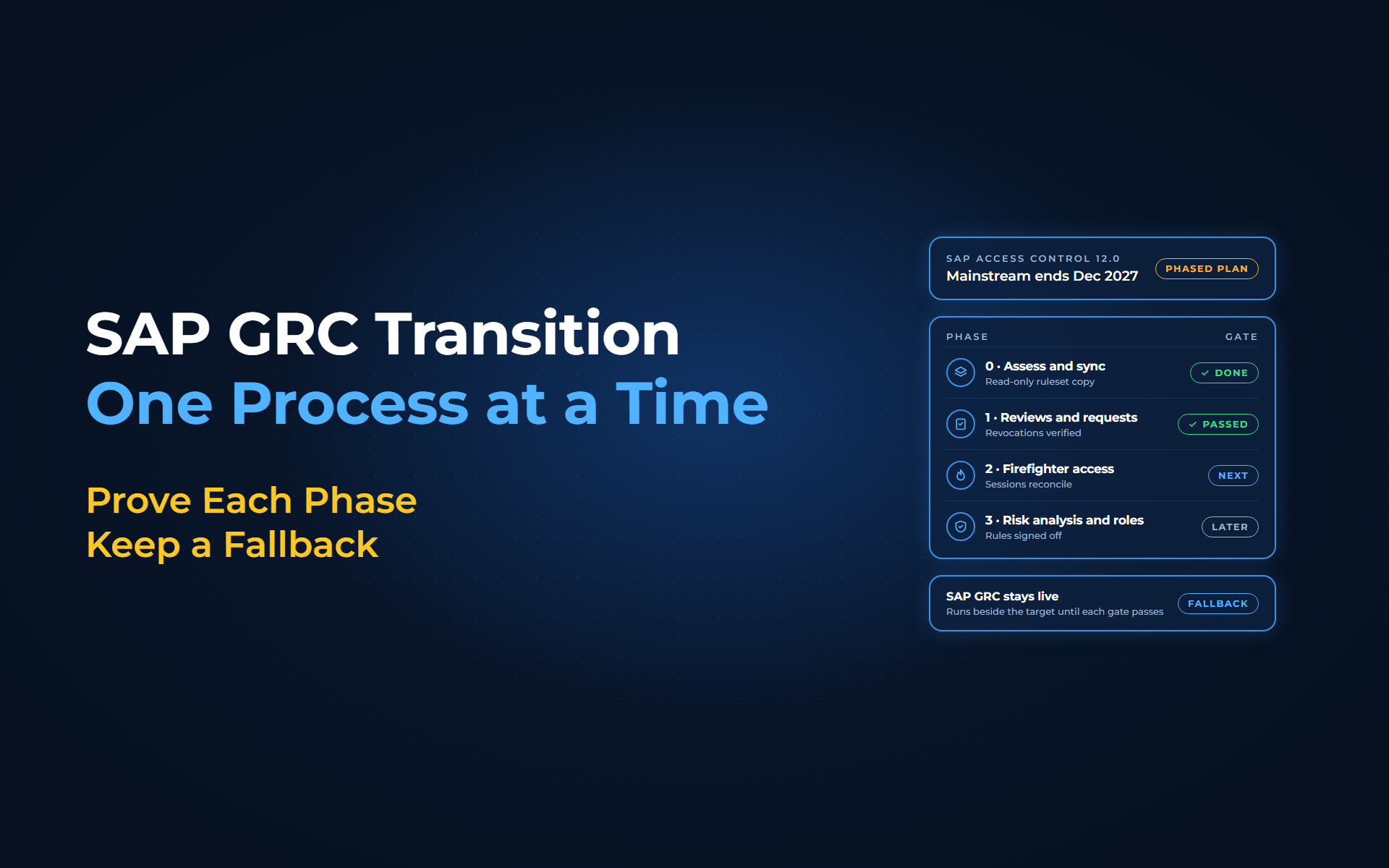
SAPinsider reports that mainstream maintenance for SAP Access Control 12.0 ends on 31 December 2027, with extended maintenance planned through 2030, so most GRC teams now have to plan their next move. The safest route is not a single weekend cutover but a phased one: access reviews and requests first, firefighter access second, and access risk analysis with role maintenance last. With Anugal running beside SAP GRC, each phase moves one process, proves it and keeps a fallback.
Why is a single cutover the riskiest SAP GRC transition option?
SAP has said SAP GRC edition for SAP HANA will replace version 12.0, and that GRC 12.0 systems must be converted to an S/4HANA-based platform to move to it. Whether you upgrade or move to another platform, a single weekend cutover carries 4 risks:
- Linked processes fail together:
SAP describes Access Control 12.0 requests as carrying "embedded risk analysis simulations." One broken rule, role owner or firefighter controller mapping can stop requests, reviews and emergency access at once. - No fallback:
Once SAP GRC is switched off, a failed mapping leaves no working process to return to. - Nothing to reconcile against:
Without a period of running both systems side by side, there is no baseline to prove the new SoD results are right. - Unreviewed emergency access:
Firefighter access touches your most sensitive transactions, and a broken log source means sessions go unreviewed.
Every one of these risks comes from switching everything at once. Anugal removes that pressure: it runs beside SAP GRC, takes over one process at a time and leaves the rest where they are until each phase is proven.
Which SAP GRC process should you move first?
After a phase 0 that moves nothing, move one process at a time:
| Phase | What moves | Gate to pass |
|---|---|---|
| 0 | Nothing; a read-only copy of the ruleset loads into the target | Copy loaded and first comparison run |
| 1 | Access reviews, then access requests | Campaign closed, revocations verified, request differences signed |
| 2 | Firefighter access | Sessions reconcile to firefighter logons |
| 3 | Risk analysis and role maintenance | Differences dispositioned rule by rule; owners sign retirement |
Access reviews go first because a campaign has the smallest blast radius: it runs on a schedule, can be piloted on one system and shows errors before revocations are fulfilled. Firefighter access waits for phase 2 because the target must first source the same logs SAP GRC collects. The SoD ruleset's system of record moves last, together with role maintenance, so roles are never redesigned against a moving ruleset.
Each phase ends when results reconcile and the owner signs.
How Anugal runs each phase beside SAP GRC
With Anugal, the agentic identity governance and access orchestration platform from Business Core Solutions, SAP GRC keeps running while each phase is proven:
- Phase 0, assess and sync:
We assess your identities, roles, connectors, workflows and SoD policies, and Anugal's embedded SAP GRC sync brings your ruleset in as the comparison copy while SAP GRC stays the system of record. - Phase 1, reviews and requests:
Anugal routes reviews to the right owners with SoD conflicts and dormant or privileged access flagged, enforces a justification for each decision and revokes rejected access in connected systems. Requests get an SoD check before approval, shadowing the SAP GRC result until the gate. - Phase 2, firefighter access:
Anugal integrates with SAP GRC EAM, so emergency access becomes approved, time-bound elevation instead of standing admin access. It records each session, helps summarise it against the approved purpose and requires a post-use review. - Phase 3, risk analysis:
Anugal's configurable SoD risk library checks conflicts across applications, not only SAP. SAP GRC components retire only after rule-by-rule differences are dispositioned and the owners sign.
Throughout, Anugal records review decisions, actions and outcomes as append-only evidence, so each gate and cutover date is backed by a record your auditor can follow. Anugal is an identity governance option, not a replacement for every SAP Process Control or Risk Management function; if SAP GRC for SAP HANA fits your estate, upgrading may be the right call.
Our view: what any target platform should prove before phase 1
Whichever platform you choose, it will run beside SAP GRC for months, so a slide deck is not enough. Before phase 1 starts, we would ask any vendor, us included, to prove 4 things on your own data:
- Rule-by-rule comparison:
It holds a read-only copy of your ruleset and compares its results with SAP GRC rule by rule. Ask whether it imports, syncs or calls the ruleset, in which direction and how often. - Reviews with risk context:
Reviewers see SoD conflicts and privileged access in the campaign, not a bare list of role names. - Firefighter review against purpose:
Each emergency session is reviewed against the purpose stated when the ID was checked out. - Parallel running:
It runs beside SAP GRC without taking over, so any phase can fall back if its gate fails.
A platform that cannot show these 4 on your ruleset is asking you to take the cutover risk on trust. We hold Anugal to the same test, and these are the 4 things we show on your own ruleset in a demo.
Where to start: a phase 0 you can run this quarter
Phase 0 moves nothing, so it carries no cutover risk and can start before your platform decision is final. List the SAP Access Control capabilities you actually use; SAP's user guide names 5 areas: Analyze Risk, Manage Access, Maintain Role, Certify Authorizations and Monitor Privileges. Name a signer for each one, because a process without an owner cannot pass a gate.
Then load a read-only copy of your ruleset and run the first comparison. With Anugal, it runs on your own ruleset through the embedded SAP GRC sync, so you see the differences before you commit to a date.
From a single risky weekend to 3 provable moves
A phased SAP GRC transition trades one high-stakes weekend for 3 smaller moves, each backed by a reconciliation, a named signer and a fallback. To see it mapped to your processes, let's get you a working demo, or write to us at info.anugal@businesscoresolutions.com.
Common questions about a phased SAP GRC transition
Which SAP GRC process do you move first in a phased transition?
Move access reviews and requests first, after a phase 0 that loads a read-only copy of the ruleset into the target. Move firefighter access second and access risk analysis with role maintenance last, so SAP GRC stays the ruleset's system of record until the end.
How long should each phase run?
Run each phase for at least a full cycle of the moved process, such as a complete review campaign or a full firefighter log review cycle. End the phase when both systems reconcile and the process owner signs, not on a calendar date. If your review campaigns run twice a year, phase 1 alone spans at least 6 months, so count your cycles back from December 31, 2027.
Why move access risk analysis last?
The ruleset is the yardstick for every earlier phase. Keeping its system of record in SAP GRC, change-controlled and copied to the target, gives request checks, reviews and firefighter reviews the same baseline and avoids redesigning roles against a moving ruleset.
Does SAP GRC 12.0 have an SAP successor?
Yes, SAP announced that SAP GRC edition for SAP HANA will replace SAP GRC 12.0, and SAP's August 2025 update said that GRC 12.0 systems must be converted to an S/4HANA-based platform to move to it. A phased approach applies whichever target you choose.
When does SAP Access Control 12.0 mainstream maintenance end?
SAPinsider reports that mainstream maintenance for SAP Access Control 12.0 ends on December 31, 2027, and that extended maintenance is planned through 2030. Confirm your own support terms with SAP before you set phase dates.
Sources
- SAP Access Control 12.0 SP27 User Guide (help.sap.com) (https://help.sap.com/doc/ca8a8544445e47f5bb0cbc8220ae01b2/12.0.27/en-US/loio8bdd50b2b1f34e049c45ded84788789c_EN.pdf). Supports the embedded risk analysis simulations in access requests, the 5 capability areas, the owner, approver and firefighter ID controller duties, and SAP's recommendation to review intended versus actual emergency access usage.
- SAPinsider, SAP Access Control 12.0 mainstream maintenance ends in 2027 (8 October 2026, secondary source) (https://sapinsider.org/articles/sap-access-control-12-0-mainstream-maintenance-ends-in-2027-extend-upgrade-or-replace). Supports mainstream maintenance for SAP Access Control 12.0 ending December 31, 2027, extended maintenance planned through 2030, and extended maintenance as a possible bridge.
- SAP News Germany, SAP GRC edition for SAP HANA announcement (July 2023, in German) (https://news.sap.com/germany/?p=174921). Supports SAP's statement that SAP GRC edition for SAP HANA will replace SAP GRC 12.0 ("wird die aktuelle SAP-GRC-Version 12.0 ablösen").
- SAP Security, Governance, Risk and Compliance update (SAP user-group PDF, August 2025) (https://assets.dm.ux.sap.com/sap-user-groups/pdfs/250821_sap_security_governance_risk_and_compliance_update.pdf). Supports SAP's August 2025 statement that GRC 12.0 systems require a conversion to S/4HANA to move to SAP GRC for SAP HANA.
- SAP Learning, hybrid scenarios lesson in the SAP Cloud Identity Access Governance implementation course (https://learning.sap.com/courses/sap-cloud-identity-access-governance-implementation-and-configuration/exploring-hybrid-landscape-scenarios). Supports SAP's hybrid set-up, which SAP calls the IAG Bridge, in which jobs sync risk and mitigation control data from SAP Access Control to SAP Cloud Identity Access Governance.
- Anugal press release, 12 October 2026 (PR Newswire) (https://www.prnewswire.com/news-releases/anugal-brings-agentic-ai-into-enterprise-identity-governance-and-access-decisions-302905593.html). Supports Anugal's Emergency Access Management summarizing firefighter activity against approved purposes (vendor source).
- Anugal press release, 14 October 2026 (PR Newswire) (https://www.prnewswire.com/news-releases/anugal-introduces-agentic-ai-led-iga-modernization-strategy-replace-migrate-or-extend-302908088.html). Supports Anugal's descriptor, the assessment of identities, roles, connectors, workflows and SoD policies, retiring legacy components after sign-off, parallel operations and the initial scope assessment (vendor source).
- Anugal FAQs (anugal.ai) (https://anugal.ai/faqs/). Supports the embedded SAP GRC sync and coexistence with SAP GRC (vendor source).
- Anugal Access Certifications (anugal.ai) (https://anugal.ai/access-certifications/). Supports owner-routed reviews, flagged SoD conflicts and dormant or privileged access, automatic revocation and recorded justification and timestamps (vendor source).
- Anugal Enforce Segregation of Duties (anugal.ai) (https://anugal.ai/enforce-segregation-of-duties-sod/). Supports SoD checks before approval, the configurable SoD risk library across applications and time-bound, traceable mitigations (vendor source).
- Anugal Emergency Access (Firefighter) (anugal.ai) (https://anugal.ai/emergency-access-firefighter/). Supports approved, time-bound elevation, no standing admin accounts, session recording and mandatory post-use review (vendor source).