

Role Redesign for SAP GROW, S/4HANA & ECC Migrations
Migration is when SAP role design gets reopened, and the moment not to carry spreadsheet debt into the new system. How to redesign roles once, and cleanly.
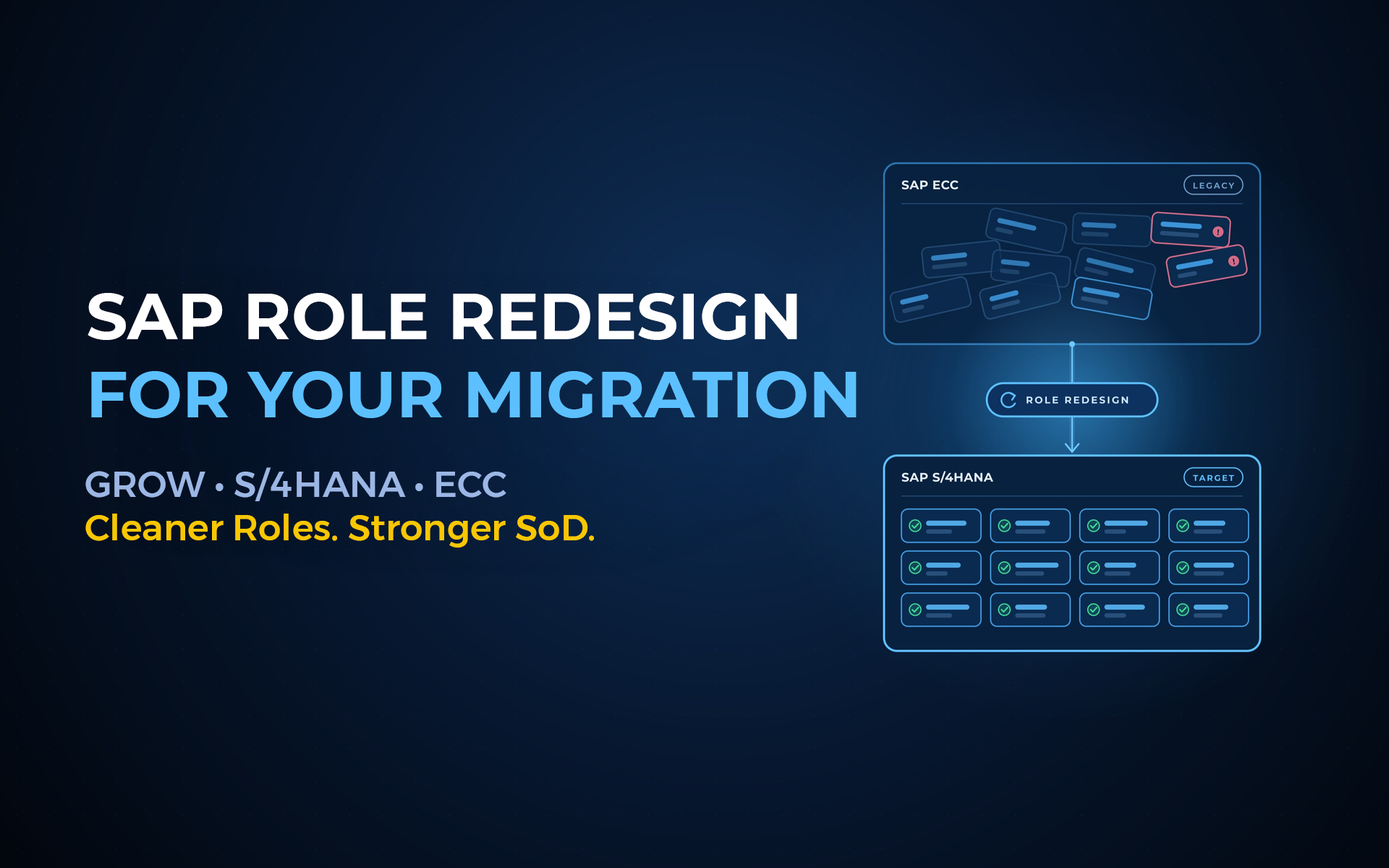
A migration to S/4HANA is the one moment a program has permission to reopen every role in the estate. Budgets exist, attention is high, and the roles are on the table anyway. It is the best chance in a decade to fix role design, and the easiest chance to waste, by lifting the old spreadsheet roles straight into the shiny new system.
If your organization is planning SAP GROW, an S/4HANA move, or an ECC migration, this post is about using that moment well.
The Short Answer
Migration projects like SAP GROW, S/4HANA, and ECC moves reopen the entire role estate, which makes them the natural moment to redesign roles cleanly rather than carry legacy spreadsheet roles forward. Doing it once, with a governed engine that structures roles from the business process and prevents SoD conflicts, avoids importing old debt into the new platform.
Why migration is the moment
Role design usually gets deferred because reopening roles outside a project is disruptive and thankless. A migration removes that excuse. The system is changing, the processes are being reviewed, and the roles have to be rebuilt or remapped regardless. The marginal cost of doing them properly, instead of lifting and shifting, is at its lowest exactly here.
The reverse is also true. A migration is the fastest way to make bad role design permanent. Legacy roles carried into S/4HANA arrive with their inconsistent naming, their undocumented grouping, and their latent SoD conflicts intact, now blessed as the new standard and twice as hard to unwind.
A migration either retires your role design debt or promotes it; there is no neutral option.
What clean looks like on a migration timeline
Doing it once and cleanly means treating role design as a governed workstream, not a late-stage cutover chore. Four moves keep it clean:
- Design from the process, not the old roles. Use the business process model as the source of truth, so roles reflect how the business will run on the new system, not how the last one was configured.
- Apply one naming standard from day one. Let the engine enforce naming and process codes across every role, so the new estate is consistent from its first build.
- Prevent SoD conflicts before cutover. Split conflicting duties during design, so go-live starts clean instead of generating a remediation backlog in week one.
- Keep the designer in the loop, at scale. A governed engine produces review-ready designs fast enough to cover the whole landscape, while your team signs off. Speed without losing accountability is what makes the timeline realistic.
Design roles from the future process, not the past configuration.
Why the old way breaks on a migration
Migrations run to a fixed date, and manual role design does not scale to a fixed date across a whole landscape. Days per process, multiplied by hundreds of processes, does not fit inside a cutover plan. So teams under time pressure do the rational thing and lift the legacy roles, precisely the choice that carries the debt forward.
With SAP GROW and S/4HANA pushing organizations toward cleaner, more standardized configurations, arriving with a tangle of legacy roles undercuts the point of the move. The new platform deserves role design built for it, and the migration is the only moment the calendar allows for that.
If role design cannot keep pace with the cutover, the cutover will decide your role design for you.
The Migration Role-Readiness Checklist
- Is the business process model current enough to design roles from?
- Is there one enforced naming standard for the new estate?
- Are SoD rules captured as a matrix before role building starts?
- Can role design cover the whole landscape inside the cutover timeline?
- Do designers review and sign off, rather than lift-and-shift under pressure?
- Is legacy role debt explicitly excluded from the new system?
Mistakes that carry debt into the new system
- Lifting and shifting legacy roles to hit the date. It looks like speed. It is the most expensive option, paid back over the life of the new platform.
- Leaving role design to the end of the project. Roles designed in the cutover crunch get the least scrutiny at the moment they most need it.
- Redesigning roles without a repeatable method. A one-off clean-up on migration decays immediately if the next change goes back to the spreadsheet.
Frequently asked questions
Should we redesign SAP roles during migration?
Usually yes. Migration reopens the role estate anyway, so it is the lowest-cost moment to redesign properly instead of lifting legacy roles forward. Carrying old roles into S/4HANA imports their inconsistencies and SoD conflicts into the new system, where they are harder and costlier to fix later.
What is SAP GROW?
SAP GROW is SAP's offering for adopting cloud S/4HANA with a standardized, faster path, aimed at organizations moving to the cloud ERP. Because it emphasizes standardized configuration, it pairs naturally with clean, consistent role design rather than migrated legacy roles.
How do we redesign roles fast enough for a cutover?
Manual design rarely scales to a fixed migration date across a whole landscape. A governed engine that designs roles from the business process, applies naming, and prevents SoD conflicts produces review-ready roles fast enough to cover the estate, while designers keep sign-off. Speed comes from automation, control from the human review.
How Anugal solves it
Anugal's Role Build Agent is built for exactly this project moment, which is why migration teams are its core audience.
THE ANUGAL ROLE BUILD AGENT
- Whole-landscape coverage in the timeline. The agent turns manual process review into a repeatable automated pass across an entire business process landscape, so redesign fits inside a cutover plan.
- Roles from the future process. It designs from the business process model, so the new estate reflects how the business will run on S/4HANA, not how ECC was configured.
- One standard from the first build. Your naming convention and process codes are applied to every role, so the new system is consistent from day one.
- Clean go-live, not a remediation backlog. SoD conflicts are split during design, so cutover starts compliant.
- Designer sign-off at scale. Review-ready role tables let your team confirm and build, keeping accountability while hitting the date.
Best suited for SAP-heavy enterprises running role redesign or SAP GROW, S/4HANA, and ECC migration projects across BFSI, manufacturing, and other regulated industries.
About Anugal. Anugal is the Agentic Identity Governance and Administration platform from Business Core Solutions (BCS). Its Role Build Agent designs clean, compliant SAP roles from business process documentation for designer review, part of a wider platform covering identity lifecycle, access requests, certifications, and emergency access across SAP and non-SAP systems.
See it on one of your processes
Bring one business process and your naming convention. We will show you the role design the Role Build Agent produces, SoD splits and all, ready for your designer to review.
Website: anugal.ai
That completes this series.