

Non-human identity governance · 6 min read
How to Measure Whether Your Non-Human Identity Governance Works
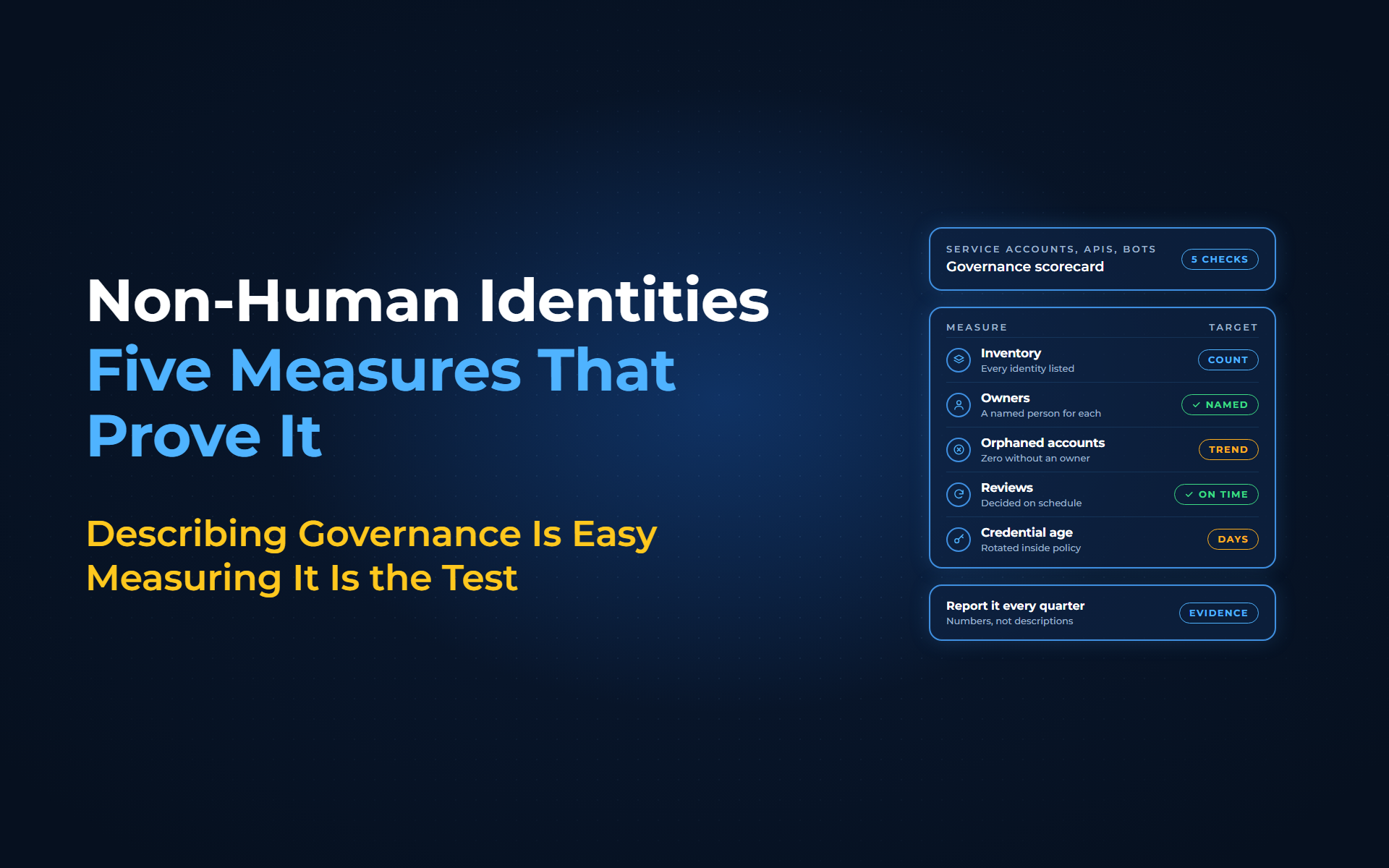
Describing non-human identity governance is the easy part. Proving it works is harder. Non-human identity governance metrics close that gap with five numbers: inventory coverage, owner coverage, orphaned accounts, review completion and credential rotation age. With Anugal, the records behind each number are kept in daily governance, not rebuilt in a quarterly spreadsheet.
The audit committee asks the CISO one question: how many of our service accounts have no named owner? The Head of IAM pulls exports from Active Directory, the cloud consoles and the SAP user list. A week later the answer is a range, not a number, and nobody knows if it beats last quarter.
If you cannot count it, you cannot show the board it is under control.
What are the non-human identity governance metrics that matter?
You already know why non-human identity (NHI) governance matters. Each of these five measures maps to a control that published standards ask for:
| Measure | What it proves | Outside reference |
|---|---|---|
| Inventory coverage | You can see every non-human identity | CIS Controls Safeguard 5.5 |
| Owner coverage | A named person answers for each one | CIS Safeguard 5.5; NIST SP 800-53 AC-2 |
| Orphaned accounts | Offboarding works for machines too | OWASP NHI1:2025; CIS Safeguard 5.3 |
| Review completion | Access is still justified | NIST SP 800-53 AC-2; CIS Safeguard 5.5 |
| Credential rotation age | Secrets do not live forever | NIST SP 800-53 IA-5; OWASP NHI7:2025 |
How do you check each of the five measures?
Run each one as a question check. You set the targets.
1. Can you see every non-human identity?
- What to count:
Identities in your governed inventory, divided by every service account, API key, bot and integration account found in source systems. - Where the data lives:
Each directory, cloud console and ERP, with no shared list. - Bad number:
Identities found in systems but missing from the inventory, or no figure at all. - With Anugal:
One consolidated inventory, classified by system, function and risk, and unmanaged or unknown identities flagged.
2. Does every identity have a named owner?
- What to count:
Identities with a business owner and a technical owner who still work for you. CIS Safeguard 5.5 expects a service account inventory to record the "department owner, review date, and purpose". - Where the data lives:
Description fields, a CMDB entry or an old ticket. - Bad number:
Owners that are a team mailbox, a closed project or a leaver. - With Anugal:
Business and technical owners are mandatory, which prevents ownerless non-human accounts instead of finding them later.
3. How many orphaned accounts are still active?
- What to count:
Active identities whose owner, application or integration is gone, plus those unused beyond your threshold. CIS Safeguard 5.3 uses 45 days of inactivity for dormant accounts, where supported. - Where the data lives:
Usage logs per system, and decommissioning tickets that never reached the account. - Bad number:
A count that rises after every system retirement. OWASP ranks improper offboarding first in its Non-Human Identities Top 10 for 2025. - With Anugal:
Access is revoked automatically when services, jobs or integrations change, and failed deprovisioning and access drift are detected.
4. Were non-human identities in the last review?
- What to count:
Identities certified in the last cycle out of those in scope, with the owner's decision recorded. NIST SP 800-53 AC-2 asks for account reviews at a frequency you define; CIS Safeguard 5.5 says at least quarterly for service accounts. - Where the data lives:
Campaigns that cover people only, with machine accounts in a side spreadsheet. - Bad number:
Full completion while machine accounts sit outside scope, or remove decisions certified but never revoked. - With Anugal:
Non-human identities are certified periodically by their named owners. Remediation is tracked through to closure with evidence.
5. How old is the oldest credential?
- What to count:
Days since each password, key, token or certificate last changed, against your policy period per credential type. NIST SP 800-53 IA-5 leaves that period to you. - Where the data lives:
Secrets vaults, cloud consoles or, for many ERP accounts, only the system itself. - Bad number:
Credentials older than policy, or no recorded change date. OWASP lists long-lived secrets as NHI7. - With Anugal:
Credential validity and rotation are enforced by policy, with rotation records kept alongside ownership. Where a secrets vault performs the rotation, Anugal records the date against the identity.
How does Anugal keep the five numbers current?
With Anugal, inventory, ownership and rotation records for non-human identities sit in the same governed process that enforces them, so the proof comes from the control itself, not from a spreadsheet built for the audit.
Anugal governs machine and non-personal identities as first-class identity types. Its compliance insights give continuous visibility into control effectiveness and audit-ready reports without manual assembly. Your team reads all five measures from one view in Anugal instead of rebuilding them each quarter.
Two limits apply. Anugal counts identities only in systems it is connected to, so coverage depends on your connection plan. And numbers do not act on themselves: you set the targets and make sure owners act on the exceptions.
From a policy you can describe to numbers you can prove
Set a target for each measure and test whether you can produce all five today without a week of exports. To see them on your own estate, let's get you a working demo, or write to info.anugal@businesscoresolutions.com.
Non-human identity governance metrics: common questions
What are non-human identity governance metrics?
They are the numbers that show whether your controls over service accounts, APIs, bots and integration accounts work. Five cover most of it: inventory coverage, owner coverage, orphaned accounts, review completion and credential rotation age.
How often should service accounts be reviewed?
CIS Controls Safeguard 5.5 calls for service account reviews on a recurring schedule, at a minimum quarterly. NIST SP 800-53 control AC-2 leaves the review frequency to the organization.
What counts as an orphaned non-human identity?
An active identity whose owner, application or integration no longer exists, or one unused beyond the threshold you set. CIS Safeguard 5.3 uses 45 days of inactivity for dormant accounts, where supported.
How long can a service account credential go without rotation?
No single number applies. NIST SP 800-53 control IA-5 asks you to define a change period for each authenticator type, and OWASP lists long-lived secrets among its top 10 non-human identity risks for 2025.
Does Anugal set the targets for these measures?
No. Anugal keeps the inventory, ownership and rotation records the measures come from. You set the targets, decide what a bad number means for your risk appetite and make sure owners act on the exceptions.
Sources
- CIS Controls Assessment Specification, Control 5: Account Management (https://cas8.docs.cisecurity.org/en/latest/source/Controls5/). Safeguard 5.3 dormant accounts after 45 days of inactivity, where supported; Safeguard 5.5 service account inventory with department owner, review date and purpose, reviewed at a minimum quarterly.
- NIST SP 800-53 Rev. 5, AC-2 Account Management (https://csrc.nist.gov/pubs/sp/800/53/r5/upd1/final; control text read at https://csf.tools/reference/nist-sp-800-53/r5/ac/ac-2/). Assign account managers; review accounts at an organization-defined frequency.
- NIST SP 800-53 Rev. 5, IA-5 Authenticator Management (control text read at https://csf.tools/reference/nist-sp-800-53/r5/ia/ia-5/). Change or refresh authenticators at an organization-defined time period by authenticator type.
- OWASP Non-Human Identities Top 10, 2025 (https://owasp.org/www-project-non-human-identities-top-10/2025/top-10-2025/). NHI1:2025 Improper Offboarding; NHI7:2025 Long-Lived Secrets.
- Anugal: Machine and Non-Personal Identity Management (https://anugal.ai/machine-non-personal-identity-management/). Consolidated inventory, classification, mandatory business and technical owners, prevention of ownerless accounts, policy-enforced credential validity and rotation, automatic revocation when services change.
- Anugal: Insights (Compliance and Security) (https://anugal.ai/insights-compliance-security/). Continuous visibility into control effectiveness, detection of failed deprovisioning and access drift, remediation tracked to closure with evidence, audit-ready reports without manual assembly.