

SAP GRC transition · 6 min read
Who Decides on SoD When SAP GRC and a New IGA Run Side by Side?
In an SAP GRC integration with a new IGA, each segregation of duties (SoD) control needs 1 deciding system, 1 named owner and 1 evidence record. Without that split, 1 request can get 2 verdicts. With Anugal, every access decision records who approved it, under which policy and why, so you can show the split in an audit.
An accounts payable clerk asks for a vendor maintenance role, and the new IGA approves it. A week later, SAP GRC's risk analysis flags her: she can now change vendor bank details and run the payment program. Internal audit asks which answer counts. Mainstream maintenance for SAP Access Control 12.0 ends on 31 December 2027, with extended maintenance to 2030, so a move to a new IGA brings a period when both systems check the same access.
Why do SAP GRC and the IGA give 2 different SoD answers?
The 2 systems disagree when they check different things at different moments. There are 5 gaps behind a split verdict:
- Different rulesets:
In SAP Access Control, the rule set decides which access risks an analysis uses, down to transactions and authorization values. If the IGA checks an older or action-only copy, the 2 systems flag different users. - Different timing:
A ruleset change reaches a copy only at its next import, so a request approved in between is judged on old rules. SAP GRC's batch analysis can see new access only after its next sync. - Different scope:
An SAP-only ruleset cannot see a conflict spanning SAP and a non-SAP application; a cross-application check can. - Mitigations held in 1 place:
SAP GRC assigns mitigating controls to users or roles for a validity period. If the IGA does not know the control, it reports a risk SAP GRC treats as mitigated. - Owners kept in 2 lists:
With 2 owner lists, nobody holds the final word on a risk.
Which system should decide each SoD control in an SAP GRC integration?
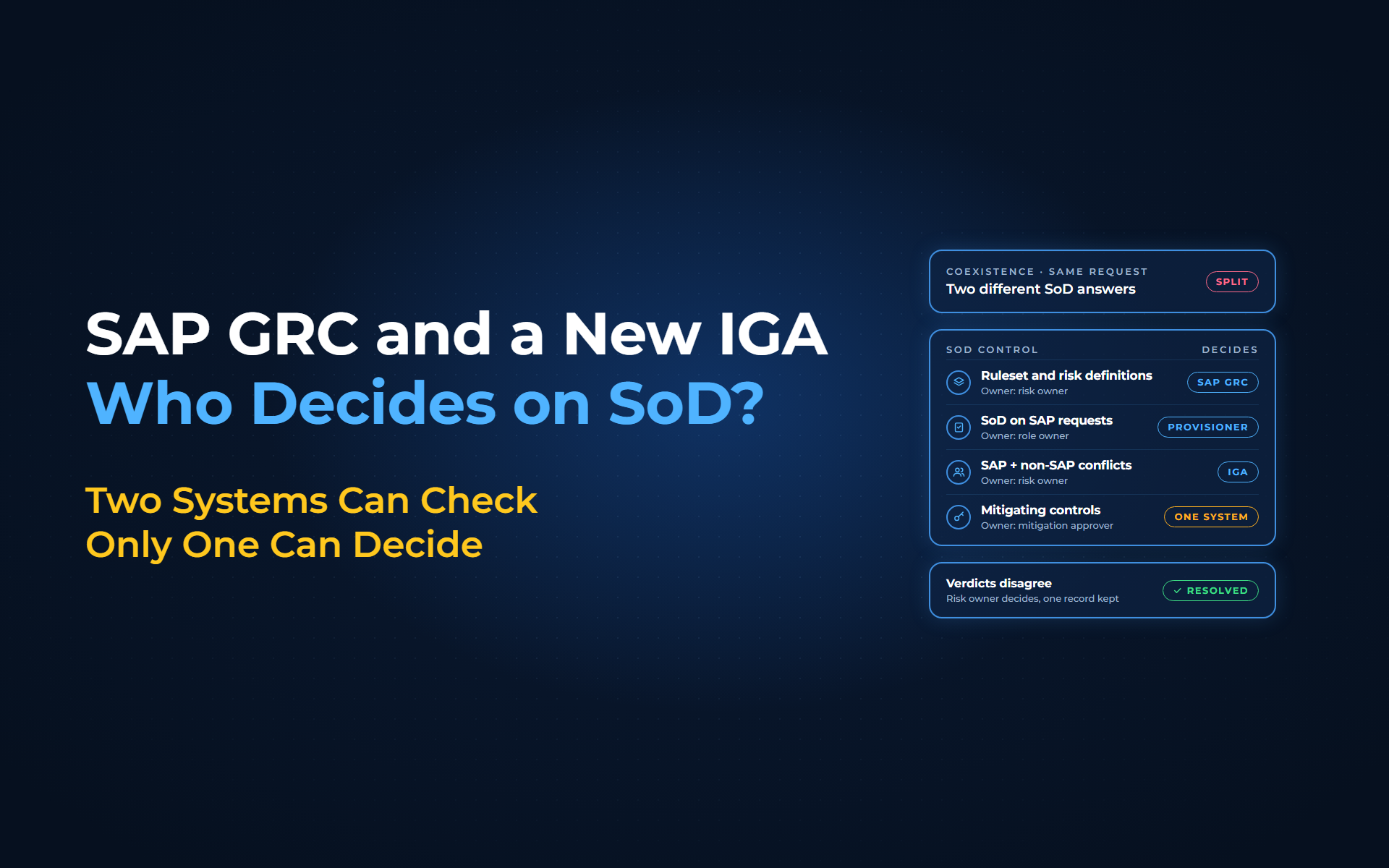
Give every SoD control 1 deciding system during coexistence, and write it down. The other system's check is a comparison, not a second approval.
| SoD control | Deciding system | Named owner | Evidence of record |
|---|---|---|---|
| Ruleset and risk definitions | SAP GRC, until you formally move the ruleset | Risk owner | SAP GRC change log plus the approved change ticket |
| SoD check on SAP access requests | The system holding the ruleset of record; the other can call it at request time | Role owner for the need, risk owner for any conflict | Request record with ruleset version and verdict |
| Conflicts spanning SAP and non-SAP | The IGA, which sees both sides | 1 named owner for the cross-application risk | IGA decision record |
| Mitigating controls | 1 system per control, never both | Mitigation approver; the monitor runs it | Assignment with validity dates, plus proof the control ran |
| Periodic SoD review | The system that runs the campaign | Reviewer named in the campaign | Campaign decisions, plus removals confirmed in SAP |
Agree on the split with the GRC owner, the Head of IAM and internal audit before parallel running starts.
What should happen when the 2 systems disagree?
When verdicts conflict, the deciding system's answer stands, and a person resolves the difference:
- Log the difference:
Record both results on the request, so nobody approves it again elsewhere. - Send it to the risk owner:
Until the risk owner decides whether the rule, the mitigation or the role assignment is wrong, treat the flag as an open SoD finding. - Fix the source, then the copy:
Change the ruleset only in the system of record. SAP's Rule Set Simulator shows the effect of a change before it reaches the production rule set. - Close with 1 record:
Keep 1 decision, 1 approver, 1 justification and 1 date.
How does Anugal keep SoD decisions clear during coexistence?
With Anugal, checks and records sit in 1 governed flow:
- 1 gate before approval:
Anugal's configurable SoD risk library evaluates cross-application conflicts before a request reaches an approver. Approvers cannot click past a policy violation: the conflict is blocked or needs an owned mitigation. The only exception is governed emergency or privileged access. - Exceptions with an owner and an end date:
High-risk combinations are blocked, routed for mitigation or escalated by policy. Every mitigation has a defined owner, scope and end date. - A decision record auditors can follow:
Anugal captures who approved, under which policy and why, and keeps risk evaluations, mitigations and approvals as structured audit records. Where SAP GRC stays the deciding system, Anugal records both verdicts on the same request and shows which was binding. - Reviews that show the conflict:
In access certifications, reviewers see SoD conflicts, and rejected access is revoked automatically in connected systems.
Anugal coexists with SAP GRC and includes an embedded SAP GRC sync. If you retire SAP GRC, it happens only after you verify and sign off on the read-only, searchable archive that holds its history. You still own the ruleset, the risk owners and the deciding system for each control; Anugal makes that choice simpler to run and helps support audit-ready evidence.
See SoD decisions recorded end to end
From 2 SoD answers to 1 decision you can defend
An SAP GRC integration works when every SoD control has 1 deciding system, 1 owner and 1 record. To see SoD decisions recorded this way, let's get you a working demo, or write to info.anugal@businesscoresolutions.com.
SAP GRC and IGA SoD decisions: common questions
Who should own the SoD ruleset during an SAP GRC integration?
Name 1 system of record and 1 named risk owner per risk. SAP describes risk owners as commonly responsible for approving changes to risk definitions, so ruleset changes go through that owner in the system of record, and the other system calls it or works from a copy refreshed after every approved change.
Why do SAP GRC and an IGA platform report different SoD conflicts?
They can check different rule versions, scopes or mitigations. A ruleset copy that lags behind SAP GRC, a cross-application rule for a system not connected to SAP GRC, or a mitigating control known to only 1 system can each produce a split verdict.
What should happen when the 2 systems disagree on a conflict?
The deciding system's verdict stands for that request. Log both results, send the difference to the named risk owner, fix the rule in the system of record and close the case with 1 decision, 1 justification and 1 date.
Who approves SoD mitigations during coexistence?
The mitigation approver for that control, in 1 system only. In SAP Access Control, mitigation approvers approve changes to a control's definition and assignments. Keeping each control in 1 system avoids a risk that looks mitigated in one tool and open in the other.
Can Anugal run alongside SAP GRC?
Yes. Anugal coexists with SAP GRC and includes an embedded SAP GRC sync, so teams can start with 1 use case, such as access certification or SoD risk governance, and expand over time while SAP GRC stays in place.
Sources
- SAP Access Control 12.0 SP27 User Guide, SAP SE, 13 January 2025 (https://help.sap.com/doc/ca8a8544445e47f5bb0cbc8220ae01b2/12.0.27/en-US/loio8bdd50b2b1f34e049c45ded84788789c_EN.pdf). Special Privileges table (risk owner and mitigation approver duties), Access Rule Maintenance (rule sets decide which access risks an analysis uses), Mitigating Controls (assignment to users, roles and profiles for a validity period), Rule Set Simulator, and rule set Change History.
- SAP Note 3326989, SAP for Me (login required): mainstream maintenance for SAP Access Control 12.0 until end of 2027, extended maintenance until 2030.
- ISACA Journal 2022, Volume 6: Benefits and Challenges of Implementing Cross System SoD Monitoring Using SAP GRC, Snehal D. Pandya (https://www.isaca.org/resources/isaca-journal/issues/2022/volume-6/benefits-and-challenges-of-implementing-cross-system-sod-monitoring-using-sap-grc). Cross-system SoD in SAP GRC relies on connectors and rules set up for each non-SAP system.
- SAPinsider: SAP Access Control 12.0 Mainstream Maintenance Ends in 2027: Extend, Upgrade, or Replace? (https://sapinsider.org/articles/sap-access-control-12-0-mainstream-maintenance-ends-in-2027-extend-upgrade-or-replace). "SAP Access Control 12.0 reaches the end of mainstream maintenance on December 31, 2027." "Extended maintenance is planned through 2030."
- Anugal: SAP GRC Transition (https://anugal.ai/sap-grc-transition/). Firefighter logs, access request history, review results, SoD violations and mitigation history are archived read-only and stay searchable; SAP GRC is decommissioned only after the archive is verified and you sign off.
- Anugal: SAP IDM End of Life 2027 (https://anugal.ai/sap-idm-end-of-life/). SAP Access Control 12.0 mainstream maintenance ends 31 December 2027, with extended support to 2030.
- Anugal: Enforce Segregation of Duties (SoD) (https://anugal.ai/enforce-segregation-of-duties-sod/). Configurable SoD risk library, cross-application conflicts during access requests, role assignments and lifecycle events; blocked, routed for mitigation or escalated by policy; documented, time-bound and traceable mitigations; structured audit records.
- Anugal: Segregation of Duties (SoD) Engine (https://anugal.ai/segregation-of-duties-sod-engine/). Compensating controls with defined ownership and scope; justifications, approvals and expiry enforced; evidence links access changes to SoD evaluation and justification.
- Anugal: Approval and Access Control Engine (https://anugal.ai/approval-access-control-engine/). Eligibility, SoD and risk evaluated at request time; approvals cannot override policy violations; captures who approved, under which policy and why.
- Anugal: Access Certifications (https://anugal.ai/access-certifications/). Reviewers see SoD conflicts; rejected access revoked automatically across target systems; append-only evidence.
- Anugal: FAQs (https://anugal.ai/faqs/). Anugal co-exists with current tools such as SAP GRC, with embedded SAP GRC sync; enterprises start with use cases such as access certification or SoD risk governance and expand gradually.