

Anugal · AI Agent Identity Governance Series
Least Privilege for AI Agents: Scope Access to the Task, Not the Role
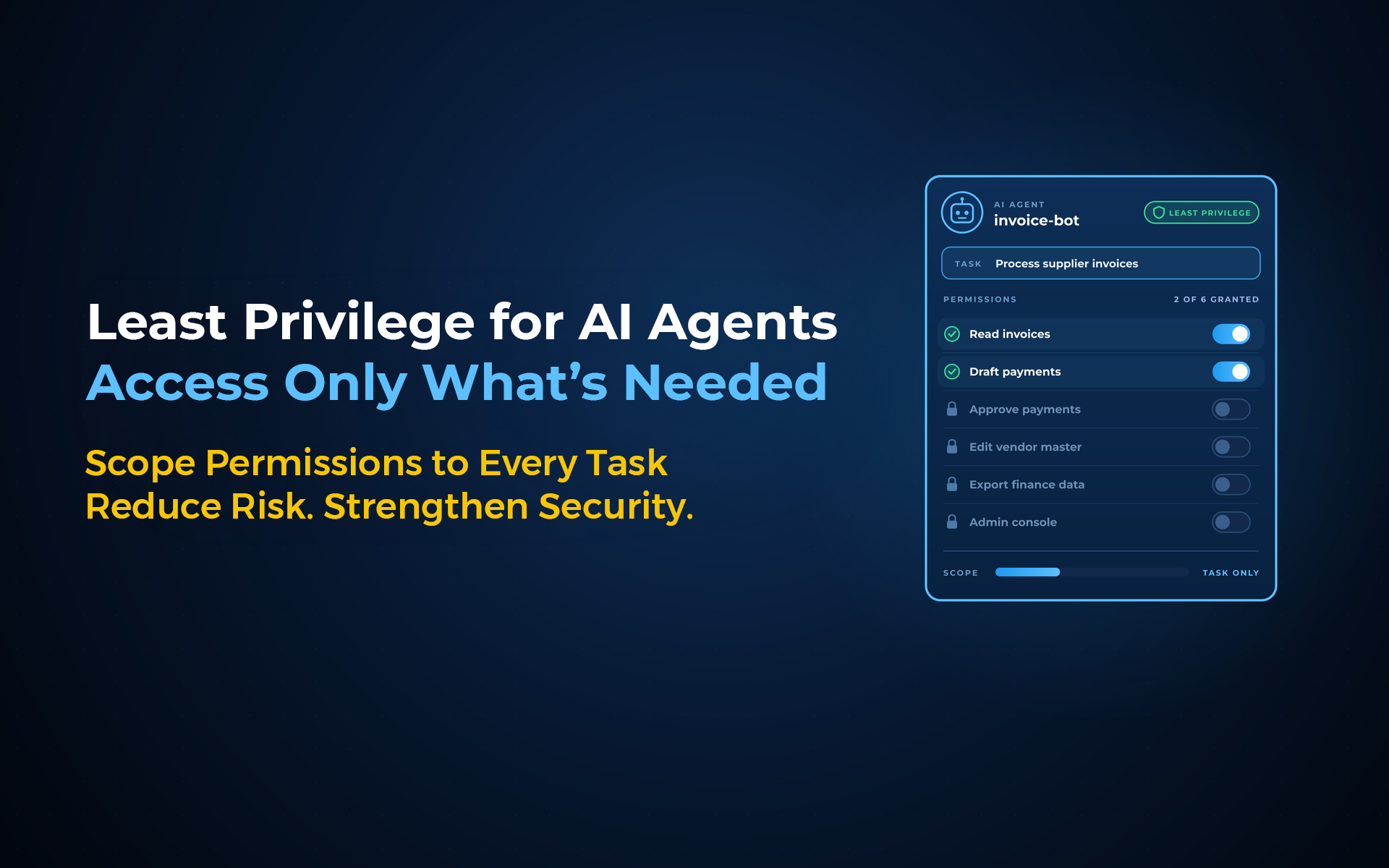
Traditional least privilege often stops at assigning a smaller role. That is not enough for AI agents. An autonomous agent can make many decisions and tool calls in seconds, so an overly broad role can become an oversized blast radius very quickly.
Task-scoped authorization is more precise than role-scoped authorization. Instead of asking only, ‘What role should this agent have?’, ask, ‘What is this agent trying to do right now, to which object, under whose authority, and for how long?’ The answer can be translated into a narrow policy decision.
For example, an agent generating a monthly finance summary may need read access to a defined data set for 30 minutes. It does not need permanent write access to the finance application. A developer agent fixing one approved issue may need access to a single repository and branch, not every project in the organization. The more autonomous the agent, the more valuable this precision becomes.
Task-scoped access also makes reviews easier. Reviewers can evaluate purpose and actual use rather than approving a generic technical role they barely understand. If the purpose changes, the access can be recalculated instead of silently accumulating.
Five questions before an agent gets access
The OWASP Top 10 for LLM Applications calls this risk Excessive Agency, and traces it to agents holding more functionality, permissions or autonomy than the task needs. Answer five questions before each grant:
- 1Which agent is asking? Identify the specific agent requesting access.
- 2In what context? Check purpose, owner, workload, environment and current risk.
- 3On what? Identify the exact data, application, API or resource.
- 4To do what? Permit only the action needed: read, create, update, execute or approve.
- 5Until when? End the access when the task or the approved time window ends.
Where Anugal fits
Anugal can help govern identities through ownership, role and entitlement controls while adding contextual intelligence and workflow orchestration around access decisions. For AI agents, this supports a path from static technical access toward policy-bound, reviewable and revocable authority.
Where to start
- Identify high-risk agent roles with broad read/write permissions.
- Break those roles into task-specific actions and resources.
- Add expiry to agent access by default.
- Use context such as environment, risk and business purpose in approvals.
- Review actual usage and remove permissions the agent does not need.
Key takeaway
See it in action
Scope your AI agents’ access to the task
See how Anugal helps move AI agent access from static technical roles toward policy-bound, reviewable and revocable authority.
References
- NIST NCCoE – Software and AI Agent Identity and Authorization initiative (2026).
- NIST publications and stakeholder work on AI-agent identity, authorization, delegation and credential security.
- Current industry guidance on non-human identity, agent discovery, ownership and runtime authorization.
- OWASP Top 10 for LLM Applications, LLM06 Excessive Agency (https://owasp.org/www-project-top-10-for-large-language-model-applications/2_0_vulns/LLM06_ExcessiveAgency.html)