

Anugal · AI Agent Identity Governance Series
AI Agent Credentials: Replace Static API Keys with Short-Lived Access
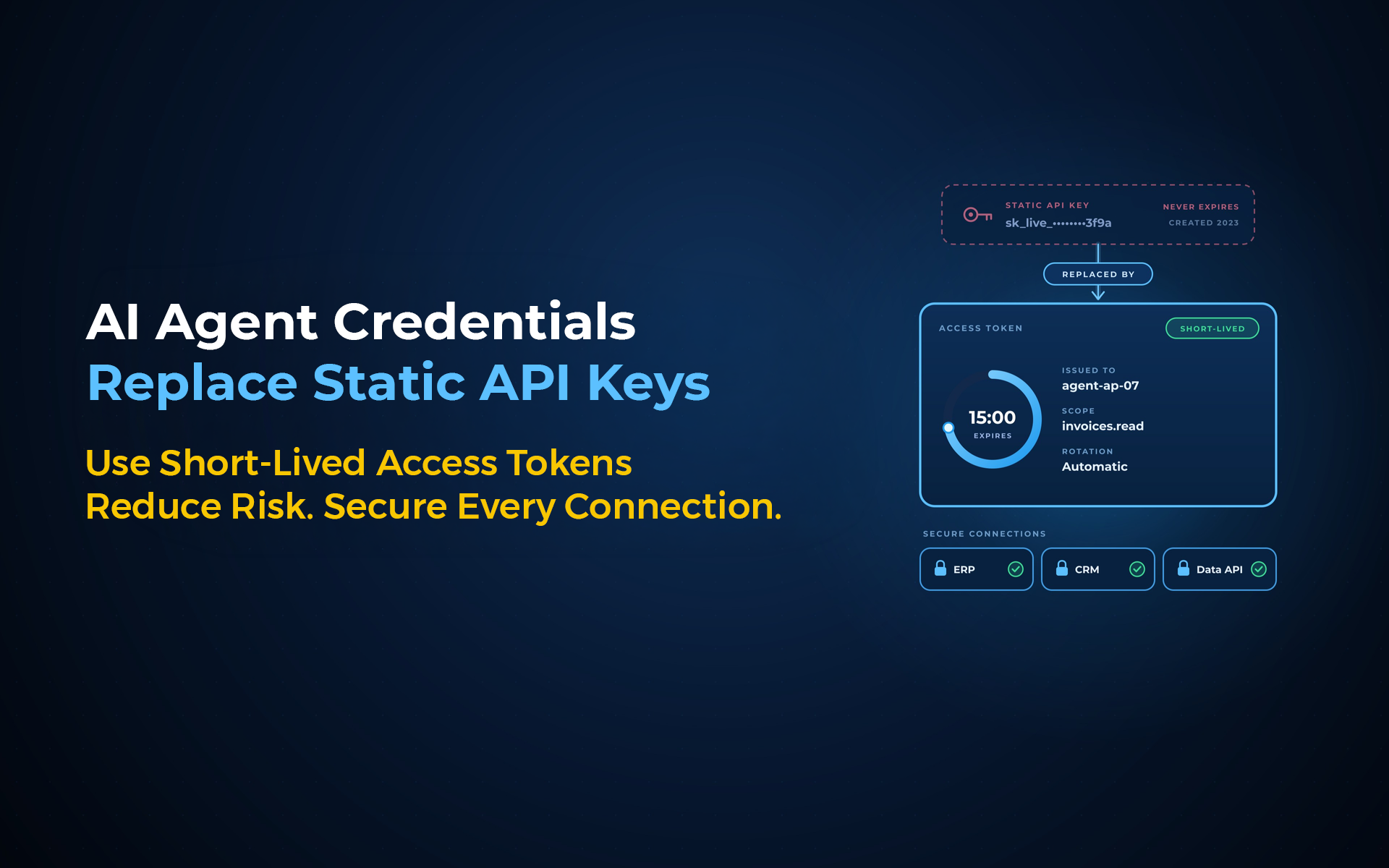
A static API key is easy to create and easy to forget. For an AI agent, that is a dangerous combination. The task may last minutes, while the credential remains valid for months. If the key is copied, leaked or embedded in another workflow, the original business context disappears but the authority survives.
Credential design should reflect the temporary nature of agent tasks. A stable agent identity does not require a permanent secret. The enterprise can keep a durable governance record for the agent while issuing short-lived operational credentials only when the agent needs to act.
This reduces exposure in two ways. First, stolen credentials lose value faster. Second, every renewal becomes a chance to re-evaluate authorization. If the agent's owner changes, the purpose is no longer approved, the environment becomes risky or the entitlement was revoked, the next credential does not need to be issued.
Static secrets also create operational friction. Teams rotate them irregularly, duplicate them across environments and struggle to identify all consumers before revocation. Moving toward time-limited and purpose-bound credentials shifts the control point from secret management to policy-driven authorization.
Five tests for an agent credential
There is no single standard for AI agent credentials yet, but existing OAuth practice covers most of what is needed, and the OWASP Non-Human Identities Top 10 lists long-lived secrets as a risk in its own right. Test each agent credential against five questions:
-
1
Is it scoped?
Limit it to the smallest set of resources and actions.
-
2
Is it bound to the agent?
Where possible, bind it to the intended agent or workload. Sender-constrained tokens, such as OAuth DPoP (RFC 9449), make a copied token much harder to use anywhere else.
-
3
Can you name its owner?
Link it to an accountable agent identity and a human owner.
-
4
Can you revoke it quickly?
Invalidate it automatically when risk or lifecycle state changes.
-
5
Does it expire soon?
Prefer short lifetimes and automatic renewal over long-lived static secrets.
Where Anugal fits
Anugal can help govern the identity, ownership, entitlement and lifecycle context around non-human identities so credential issuance and revocation can follow approved governance states. The credential then becomes a temporary proof of authority, not the permanent definition of the agent.
Where to start
- Find agent credentials that have no expiry or owner.
- Separate stable agent identity from runtime credential lifetime.
- Reduce credential scope to the exact audience, resource and action.
- Automate revocation when an agent is suspended or retired.
- Use credential renewal as a policy re-check, not only a rotation event.
Key takeaway
Keep the identity stable, but make operational credentials short-lived, scoped and revocable.
About Anugal. Anugal is the Agentic Identity Governance and Administration platform from Business Core Solutions (BCS), covering identity lifecycle, access requests, certifications, and emergency access across SAP and non-SAP systems.
Govern your AI agent identities
See how Anugal ties agent identity, ownership, entitlements and lifecycle to approved governance states, so credential issuance and revocation follow policy.
References
- NIST NCCoE - Software and AI Agent Identity and Authorization initiative (2026).
- NIST publications and stakeholder work on AI-agent identity, authorization, delegation and credential security.
- Current industry guidance on non-human identity, agent discovery, ownership and runtime authorization.
- RFC 9449: OAuth 2.0 Demonstrating Proof of Possession (DPoP), IETF, September 2023 (https://www.rfc-editor.org/rfc/rfc9449.html)
- OWASP Top 10 Non-Human Identities Risks 2025 (https://owasp.org/www-project-non-human-identities-top-10/2025/top-10-2025/)