

What Is Agentic Role Design? From Business Process to Review-Ready Roles
Agentic role design reads your business process and builds clean, compliant SAP roles for review. The five-step engine, explained, with the designer in control.
Imagine handing your business process documentation to a tireless role designer who has memorized your naming convention, never forgets a segregation-of-duties rule, and produces the same quality of work on role number 900 as on role number one. Then imagine that designer hands everything back to your human team for review before anything is built. That is agentic role design.
It is one of the clearest examples of where agentic AI genuinely belongs in the enterprise: a bounded, rules-heavy, judgment-consistent task, with a human signing off. This guide explains how it works.
The Short Answer
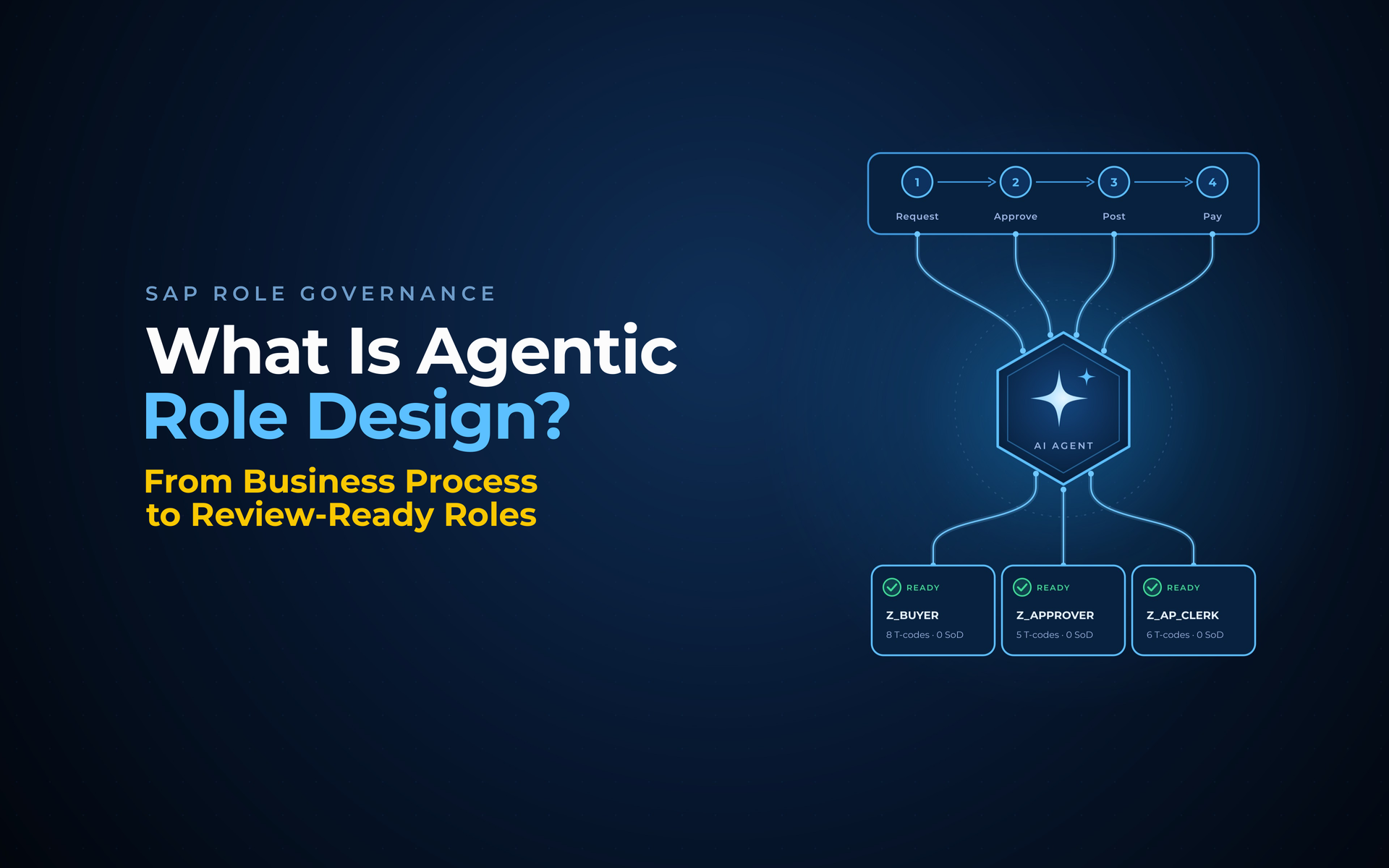
Agentic role design uses an AI agent to read business process documentation and automatically design clean, compliant SAP roles for human review. It reads the process model, classifies each task by access type, groups compatible tasks using a compatibility matrix, splits segregation-of-duties conflicts, applies the naming convention, and hands a review-ready role table to the designer to confirm and build.
Why this arrives now
SAP has put the autonomous enterprise at the center of its 2026 roadmap, and across the industry the same phrase keeps recurring: work that is repeatable and rules-based is work an agent can carry, with people moving up to review and judgment. Role design fits that description almost perfectly. It is high-volume, rule-governed, and consistency-critical, exactly the shape of task where a human's time is better spent approving than grouping.
The difference between this and a script is that the agent understands structure. It does not just match transactions to a lookup table; it reads the business process model and works from how the business is structured.
The best early home for an enterprise agent is a task that is rules-heavy, high-volume, and still needs a human to sign the result.
The five-step engine
Under the outcome sits a specific, inspectable pipeline. Five steps, in order:
- Reads the process. Ingests the business process model (BPML) and understands process and sub-process structure, not just isolated transactions. Grouping starts from the business, not from a flat transaction list.
- Classifies every task. Matches each task to a configurable access type: Display, Park, Post, Maintain, Reverse, Close, Approve, or Execute. This is the vocabulary the rest of the engine reasons with.
- Groups compatible tasks. Builds role buckets using a compatibility matrix that defines which access types can safely sit together, so grouping follows a rule rather than a hunch.
- Applies segregation of duties. Automatically splits any group that combines conflicting duties, such as posting and approving, before a role is ever built. Prevention happens here, in design.
- Names and delivers. Applies your naming convention and business process codes, then hands a complete role design table to the designer for review and sign-off.
Every role runs the same five steps, so role nine hundred is built to the same standard as role one.
Why configurable beats rigid
A common fear with automation is that it forces your organization to work the tool's way. Agentic role design inverts that. Organization-wide standards, project-level adjustments, and customer-specific extensions all feed the same rule engine. The agent adapts to your conventions without changing how it operates.
That matters because no two SAP estates structure roles identically, and no single project is quite like the last. A rigid tool would need reconfiguring or overriding constantly. A configurable engine absorbs the differences as rules, so the method stays constant while the output fits each context.
The rules change to fit you; the engine that applies them does not.
Where the human stays in the loop
The agent does not build roles into production. It produces a ready-to-review role design table. The designer reviews it, adjusts if needed, confirms, and builds. Human accountability sits exactly where governance frameworks expect it: with a named person who signs off.
This is the Advisory-to-Assisted pattern from responsible agentic design. The agent does the heavy, repeatable analysis and recommends a complete design; the human holds final authority. As trust builds on your own results, you decide how much of the routine to let run, never the other way around.
The agent designs; the designer decides. That order is the governance.
The 5-Stage Role Build Pipeline
Five stages turn a business process into review-ready roles:
- Read the business process model, including sub-process structure.
- Classify each task by access type (Display, Post, Approve, and the rest).
- Group compatible access types using the compatibility matrix.
- Split any segregation-of-duties conflict before the role is built.
- Apply naming and business process codes, then deliver for designer sign-off.
Mistakes when adopting agentic role design
- Expecting it to remove the reviewer. The value is a review-ready design, not an unattended one. Keeping the designer is the feature, not a limitation.
- Feeding it poor process documentation. The engine reasons from the business process model. A vague or outdated model produces vague roles. Good input is part of the method.
- Skipping the compatibility matrix setup. The matrix is where your SoD policy lives. Rushing it hands the engine an incomplete rulebook, and prevention is only as good as the rules.
Frequently asked questions
What is agentic role design?
An approach where an AI agent reads business process documentation and designs SAP roles for human review, applying access-type classification, a compatibility matrix, segregation-of-duties rules, and your naming convention. The agent produces a review-ready design; a human designer confirms and builds it, keeping accountability in the loop.
Does the AI build roles automatically?
No. It produces a complete, ready-to-review role design table. Your designer reviews, adjusts if needed, signs off, and builds the roles. The agent handles the repeatable analysis and recommendation; the human holds final authority, which is what keeps the process auditable.
What is a BPML in this context?
A business process model or list: structured documentation of how a business operates, broken into processes and sub-processes. The agent reads it to understand which tasks belong to which process, so roles are grouped around the business structure rather than around a flat list of transactions.
How is this different from an SoD violation report?
A violation report finds conflicts after roles exist. Agentic role design prevents them during design, splitting conflicting duties before a role is built. One is detection and cleanup; the other is prevention. Part 3 of this series covers that distinction in depth.
How Anugal solves it
Everything above describes Anugal's Role Build Agent, which is the product this pattern comes from.
THE ANUGAL ROLE BUILD AGENT
- Reads your process model. Ingests the BPML and understands process and sub-process structure, so grouping reflects the business.
- Classifies against eight access types. Display, Park, Post, Maintain, Reverse, Close, Approve, Execute, the vocabulary the engine reasons with.
- Groups by compatibility matrix. Role buckets follow defined rules about which access types can safely coexist.
- Splits SoD conflicts in design. Conflicting duties are separated automatically before any role is built.
- Applies your naming and delivers for review. Your convention and process codes are applied, and a complete role design table goes to your designer to confirm and build.
Best suited for SAP-heavy enterprises running role redesign or SAP GROW, S/4HANA, and ECC migrations, which Part 4 covers directly.
About Anugal. Anugal is the Agentic Identity Governance and Administration platform from Business Core Solutions (BCS). Its Role Build Agent designs clean, compliant SAP roles from business process documentation for designer review, part of a wider platform covering identity lifecycle, access requests, certifications, and emergency access across SAP and non-SAP systems.
See it on one of your processes
Bring one business process and your naming convention. We will show you the role design the Role Build Agent produces, SoD splits and all, ready for your designer to review.
Website: anugal.ai