

ANUGAL UAC SERIES · 2 OF 6 · PROBLEM
Why Access Reviews Get Rubber-Stamped (and the Fix)
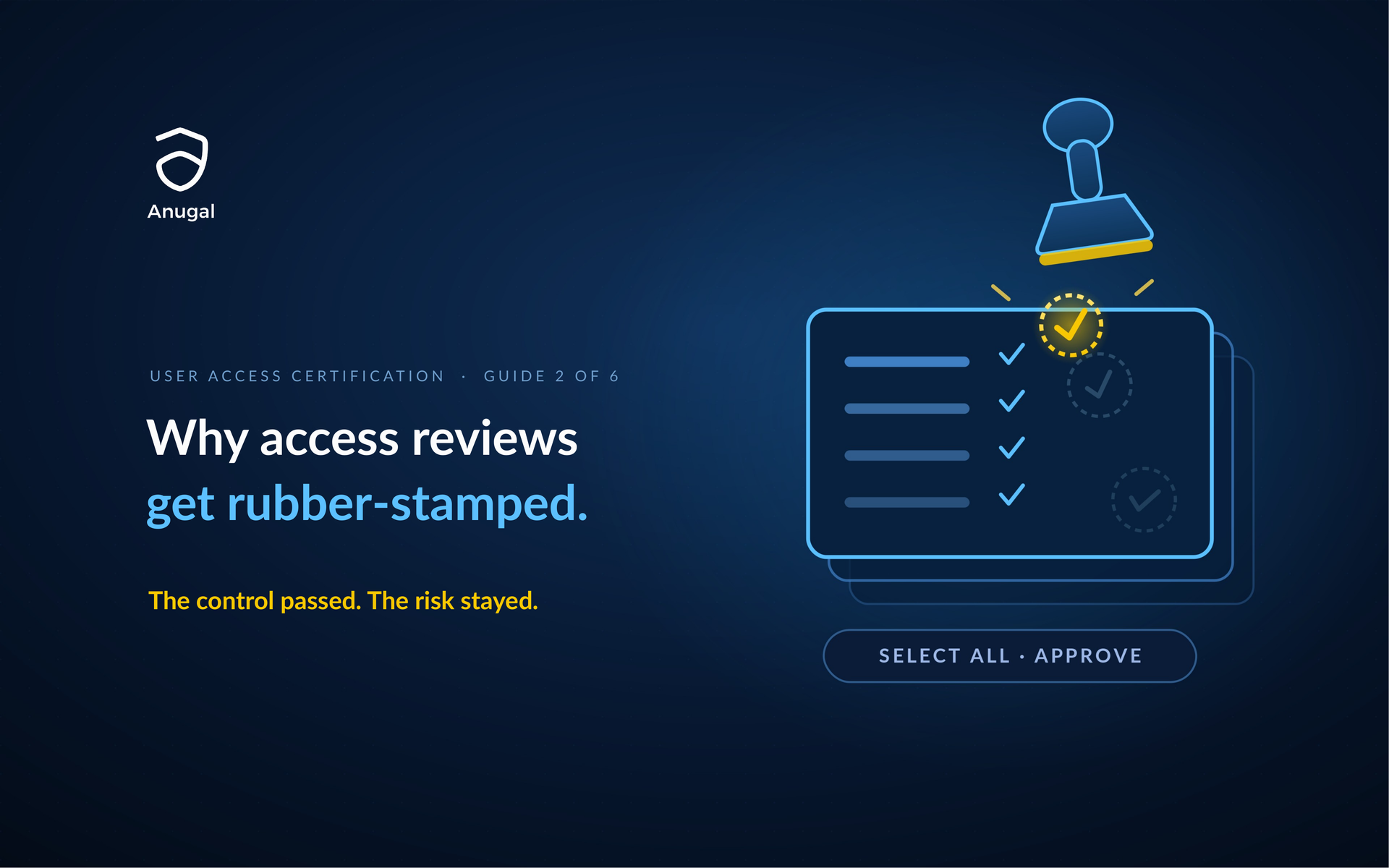
Friday, 4 p.m. A plant manager opens a certification with 900 rows. Each row is a technical role name she has never seen, for people she manages across three shifts. The deadline is Monday. She does what reviewers in large enterprises do every quarter: select all, approve. The control passed. The risk stayed.
THE SHORT ANSWER
Access reviews get rubber-stamped when volume outruns context: hundreds of technical entitlements per reviewer, no history, no risk signal, and a deadline. The fix is not training; it is shrinking the pile. Auto-approve low-risk access under policy, translate the rest into plain language, and route only genuine decisions to humans.
Why do good managers approve everything?
Because the screen gives them nothing to judge with. Entitlement strings and transaction codes instead of business meaning. No history of who granted what, or when, or why. No signal separating a payroll administrator's write access from a read-only report viewer. And one row among hundreds, exactly as it plays in Anugal's 90-second certification story.
Writing on SOX access reviews describes the same mechanics: high-impact access buried beside low-risk items, and managers rubber-stamping to meet deadlines or revoking blind and dealing with the fallout.
Rubber-stamping is not a character flaw; it is the rational response to a screen with no information.
What it costs at enterprise scale
Every rubber-stamped campaign leaves the estate exactly as it was, plus a signature saying someone checked. Access creep compounds quarter over quarter. And with 90 percent of large organizations reporting an identity-related incident in the past year per the IDSA's 2024 study, unreviewed access widens the blast radius of whichever incident arrives.
| Symptom | Consequence | Owner |
|---|---|---|
| Approval rates near 100 percent | The preventive control exists on paper only; creep compounds | CISO |
| Findings citing insufficient review procedures | Remediation cycles, re-testing, board attention | IT Risk and Compliance |
| Reviewers disengage | The one campaign that matters gets the same select-all | Head of IAM |
Every rubber-stamped campaign converts preventive control into paperwork.
How do you shrink the pile?
You stop sending humans what a policy already answers, and you light up what remains. Four mechanisms do the work, with outcome figures per Anugal's UAC materials, stated as our claims:
- Auto-approve the obvious under policy. Birthright access, non-movers, and standard role-aligned entitlements certify automatically; only risk-scored exceptions route to humans. Approval volume drops 20 to 30 percent.
- Translate the rest into plain language. LLM-driven rationale turns entitlements, transaction codes, and SoD conflicts into clear approve, revoke, or justify guidance. Interpretation time falls 60 to 70 percent.
- Put the context on the row. Role, usage, license, SoD, and access history per user, with peer-group comparison and anomaly flags, ending manual lookups across SAP, AD, and HR. Review efficiency gains 40 to 50 percent.
- Meet reviewers where they work. Prioritized queues arrive in Microsoft Teams with insights inline, bulk review for low-risk items, and mobile one-tap decisions.
The goal is fewer decisions, better lit.
The Rubber-Stamp Test: 5 signs
Two or more of these and your control is a ceremony.
THE RUBBER-STAMP TEST
- Approval rate above 98 percent, campaign after campaign.
- Median decision time under five seconds per row.
- Zero revocations in the last two campaigns.
- Reviewers routinely ask what a role grants.
- Your last audit noted evidence or scrutiny gaps in review procedures.
Mistakes that make it worse
- Blaming reviewers and scheduling training. The reviewer is responding rationally to an irrational screen. Fix the screen.
- Sending everything to everyone. Without risk scoping, the CFO's SAP access and a viewer license get identical attention: none.
- Reviewing less often to reduce volume. The pile shrinks per campaign and the exposure window doubles. Filter by risk instead.
Frequently asked questions
What does rubber-stamping mean in access reviews?
Approving access without genuine scrutiny. It shows up as near-total approval rates, seconds-per-row decision times, and zero revocations, usually because reviewers face high volumes of technical entitlements with no business context and a deadline.
Is auto-approval safe?
Under policy, yes. Auto-approval applies to birthright, non-mover, and standard role-aligned access, governed by written rules with every decision logged. Risk-scored exceptions still route to accountable humans, so scrutiny concentrates exactly where it earns its keep.
How do you measure review quality?
Look past completion. Track revocation rate, median decision time, exception handling, and whether findings recur. A campaign that completes at 100 percent while changing nothing measured nothing.
How Anugal solves it
Anugal UAC attacks the volume, the darkness, and the friction at the same time.
HOW ANUGAL SOLVES IT
- Intelligent risk filtering and auto-approval. Birthright and standard role-aligned access certifies under policy; only risk-scored exceptions reach humans. Approval volume down 20 to 30 percent (vendor claim).
- Plain-language decision rationale. Entitlements, transaction codes, and SoD conflicts translated into approve, revoke, or justify guidance. Interpretation time down 60 to 70 percent (vendor claim).
- Context and AI summaries on every row. Role, usage, license, SoD, and history per user, ending lookups across SAP, AD, and HR. Review efficiency up 40 to 50 percent (vendor claim).
- Reviews inside Microsoft Teams. Prioritized queue, insights inline, bulk low-risk review, one-tap decisions on mobile.
- Everything logged. Every recommendation, decision, and override lands in the audit trail automatically.
Test the numbers against your own data: one recent campaign export is enough for a pilot comparison.
About Anugal. Anugal is the Agentic Identity Governance and Administration platform from Business Core Solutions (BCS). It orchestrates identity lifecycle, access requests, certifications, and risk governance across the enterprise, with 350+ integrations through SCIM 2.0, REST APIs, OData, SOAP, SAP ABAP, and SQL.
SEE IT ON YOUR OWN CAMPAIGN DATA
Bring one recent certification export and we will show you what Anugal UAC surfaces in it: the risk, the rubber-stamps, and the revocations that never executed.
hello@businesscoresolutions.com
Next in this series is live: Toxic Access Combinations: How One Role Change Creates Them