

ANUGAL COMPARISON SERIES · 2 OF 4 · REFRAME
Identity Governance or SAP Threat Detection? Choosing the Right Layer
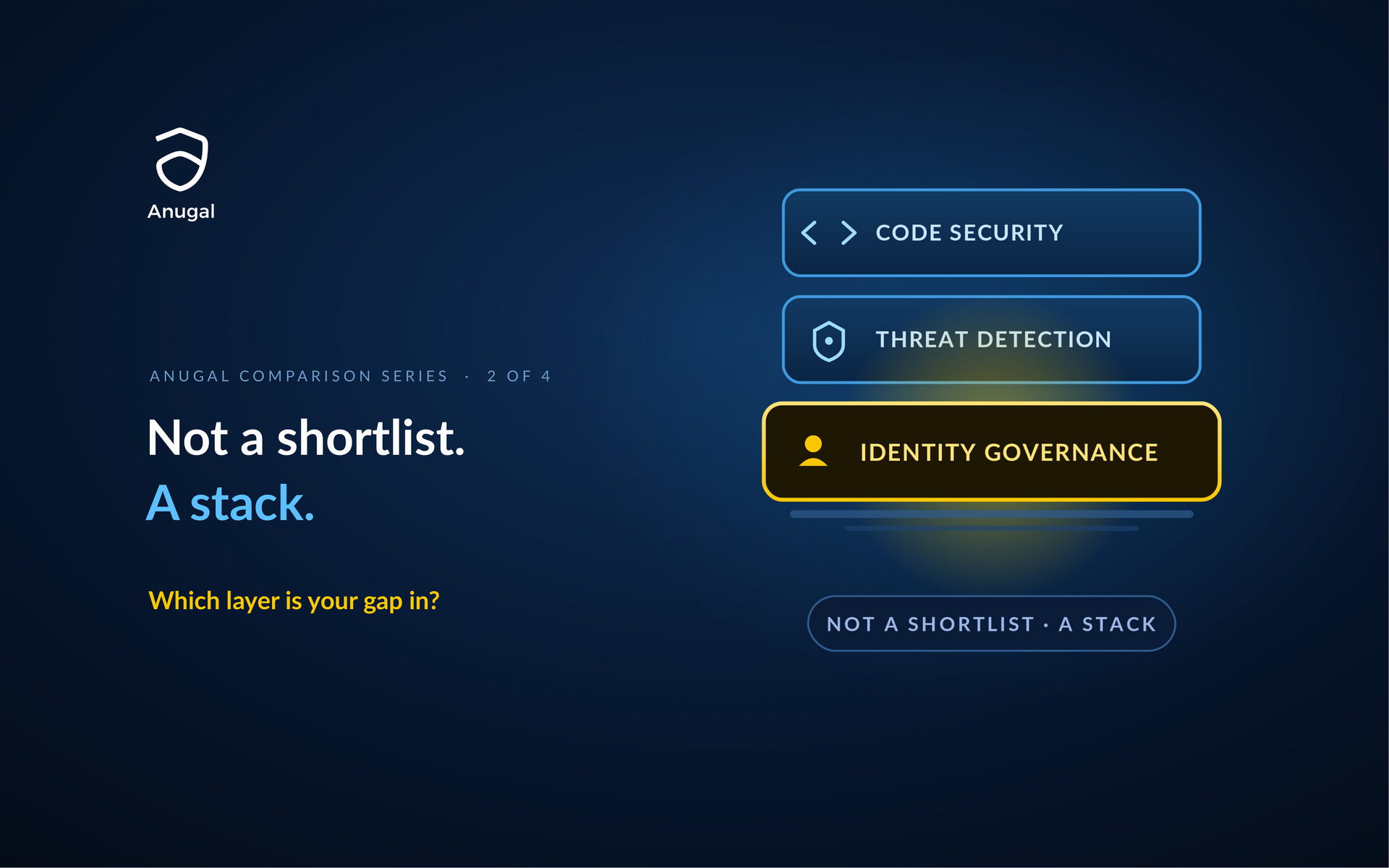
A security leader lines up Anugal, SecurityBridge, and Onapsis and asks the team to pick one. It is the wrong exercise. These tools do not sit on a shortlist competing for one slot. They sit in a stack, on different layers, and the useful question is which layer your gap is in.
THE SHORT ANSWER
SAP security has distinct layers: identity governance (who should have access), threat detection and vulnerability management (what is attacking or exposed), and code security (flaws in custom ABAP and HANA). IGA tools like Anugal own the first layer; SecurityBridge and Onapsis own the others. Most mature estates need more than one layer.
The 2026 pressure on the governance layer. As SAP pushes the autonomous enterprise and AI agents begin acting inside business workflows, a new population of non-human identities needs governing: service accounts, copilots, and agents that can hold access exceeding their human creators. The industry consensus for 2026 is blunt: organizations are trying to govern machine-speed identities with human-speed processes. That gap lives squarely in the governance layer, which is why deciding who owns it, before layering threat detection on top, is the sequencing question this post is about.
Why one-tool thinking fails
Because the layers answer questions that do not substitute for each other. A threat-detection platform will not tell you that a mover kept finance access they should have lost. An IGA platform will not tell you the SAP kernel is missing a critical patch. Buy only one and you have covered one question well and left the others open, which is how estates end up with a strong scanner and ungoverned access, or clean governance on an unpatched system.
Picking one layer and calling it SAP security is like locking the front door and leaving the windows open.
The three layers, plainly
| Layer | The question it answers | Tools that own it |
|---|---|---|
| Identity governance (IGA) | Who should have access, to what, for how long, and can you prove it? | Anugal; SAP GRC and Saterion for SAP-specific slices |
| Threat detection & vulnerability | What is attacking us, and where are we exposed or unpatched? | SecurityBridge; Onapsis (SAP and Oracle) |
| Code security | Are there flaws in our custom ABAP and HANA code? | SecurityBridge; Onapsis (AST in code) |
Read across and the overlap makes sense: several tools show compliance dashboards and access-risk features, because those touch every layer. The differences live at the edges, and the edges are where you decide.
The overlap is real but shallow; the differentiation lives at the edges.
Which layer is your gap in?
A short diagnostic, honestly answered, points at the layer before it points at a vendor.
- Do you know, today, who can approve a payment and create the vendor being paid? A governance gap.
- Would you detect a privilege-escalation attack on SAP in real time? A threat-detection gap.
- Do you scan custom ABAP for exploitable code before it ships? A code-security gap.
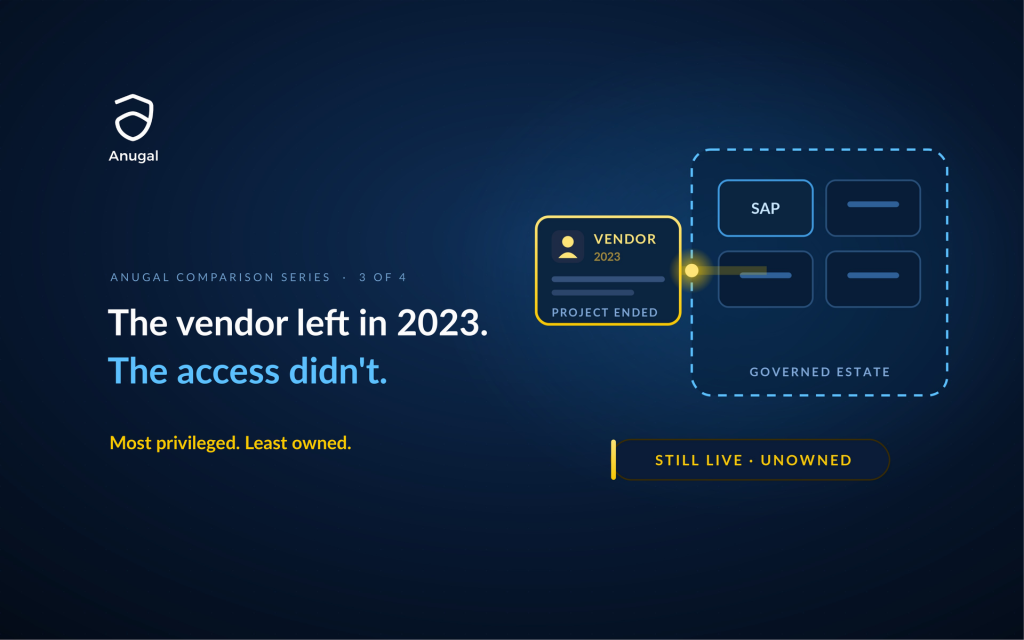
- Can external vendors get access without a governed lifecycle around it? A governance gap.
- Is your SAP kernel patch status visible and current? A vulnerability-management gap.
Where your uncomfortable answers cluster is the layer to buy first. Not the vendor with the best demo, the layer with your biggest hole.
How the layers work together
The layers reinforce each other. Governance decides who should hold access and proves it to auditors. Threat detection watches how that access behaves and catches misuse in real time. Code security keeps the custom code underneath from becoming the way in. A finding in one often needs another to resolve: a threat tool flags anomalous access, and a governance tool is where you fix who holds it.
Governance sets the rules, detection watches the behavior, and code security guards the foundation.
Mistakes in stacking the layers
- Buying the loudest layer instead of your weakest. Threat detection demos well; ungoverned access fails audits quietly. Buy for your gap, not the demo.
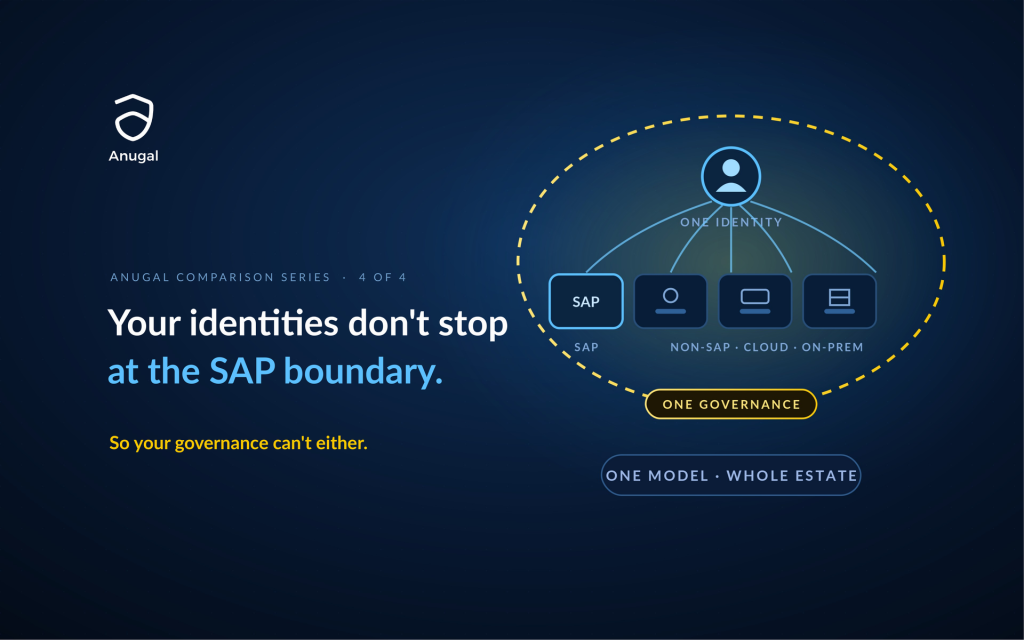
- Assuming SAP-only tools cover a hybrid estate. If identity crosses into non-SAP systems, an SAP-only layer leaves that governance uncovered.
- Treating compliance dashboards as equivalent. Every tool shows compliance views; they report on different layers and do not substitute for one another.
Frequently asked questions
Is IGA the same as SAP security?
No. Identity governance is one layer of SAP security, the layer that decides and proves who should have access. It sits alongside threat detection, vulnerability management, and code security, which defend the system itself. A complete posture needs governance plus at least one defensive layer.
Can one tool cover all the layers?
Not well. Tools are built for a primary layer and show partial features in others. SecurityBridge and Onapsis lead in detection and vulnerability; Anugal leads in identity governance and vendor access. Expecting one product to own every layer usually means accepting weakness in most of them.
Where does SAP GRC fit?
SAP GRC sits largely in the governance layer for SAP, with access control and risk analysis. Anugal complements it by extending governance across non-SAP systems and adding vendor-access lifecycle and Teams-native workflows, broadening the layer rather than replacing GRC.
How Anugal solves it
Anugal owns the governance layer, and is built to sit cleanly beside whatever you choose for the others.
WHERE ANUGAL IS THE RIGHT CHOICE
- A complete governance layer. Access, SoD, certifications, and vendor lifecycle across SAP and non-SAP, which is the whole first layer rather than a slice of it.
- Coexistence by design. Complements SAP GRC and pairs with SecurityBridge or Onapsis, so the governance layer strengthens the defensive ones instead of duplicating them.
- Hybrid reach. Native non-SAP support means the governance layer does not stop at the SAP boundary, where the SAP-only tools do.
- Evidence across the stack. Identity analytics and audit-ready reviews give the whole stack a governance record aligned to SOX, ISO 27001, SOC 2, NIS2, and CSCRF.
If your biggest gap is threat detection or patching, buy that layer first; then let Anugal govern the identities on top of it. That order is honest, and it is usually right.
About Anugal. Anugal is the Agentic Identity Governance and Administration platform from Business Core Solutions (BCS). It unifies identity lifecycle, access requests, certifications, vendor access, and risk governance across SAP and non-SAP systems, with 350+ integrations and a Microsoft Teams-native experience.
MAP IT TO YOUR ESTATE
Bring your current SAP and non-SAP security stack and we will map exactly where Anugal fits alongside it, and where it does not. An honest 30-minute walkthrough, no slideware.
Next in this series is live: Vendor Access Management: The Capability SAP Security Tools Skip