

ANUGAL · SAP IDM 2027
SAP IDM End of Life 2027: Replacement & Migration Guide
How to assess your current SAP Identity Management environment, define the right target architecture, and plan a controlled transition before the maintenance deadline.
Reader takeaway
Do not begin with the question, “Which product replaces SAP IDM?” Begin with the controls, workflows, integrations and governance outcomes SAP IDM performs today — then decide where each should live tomorrow.
SAP IDM is approaching a decision point
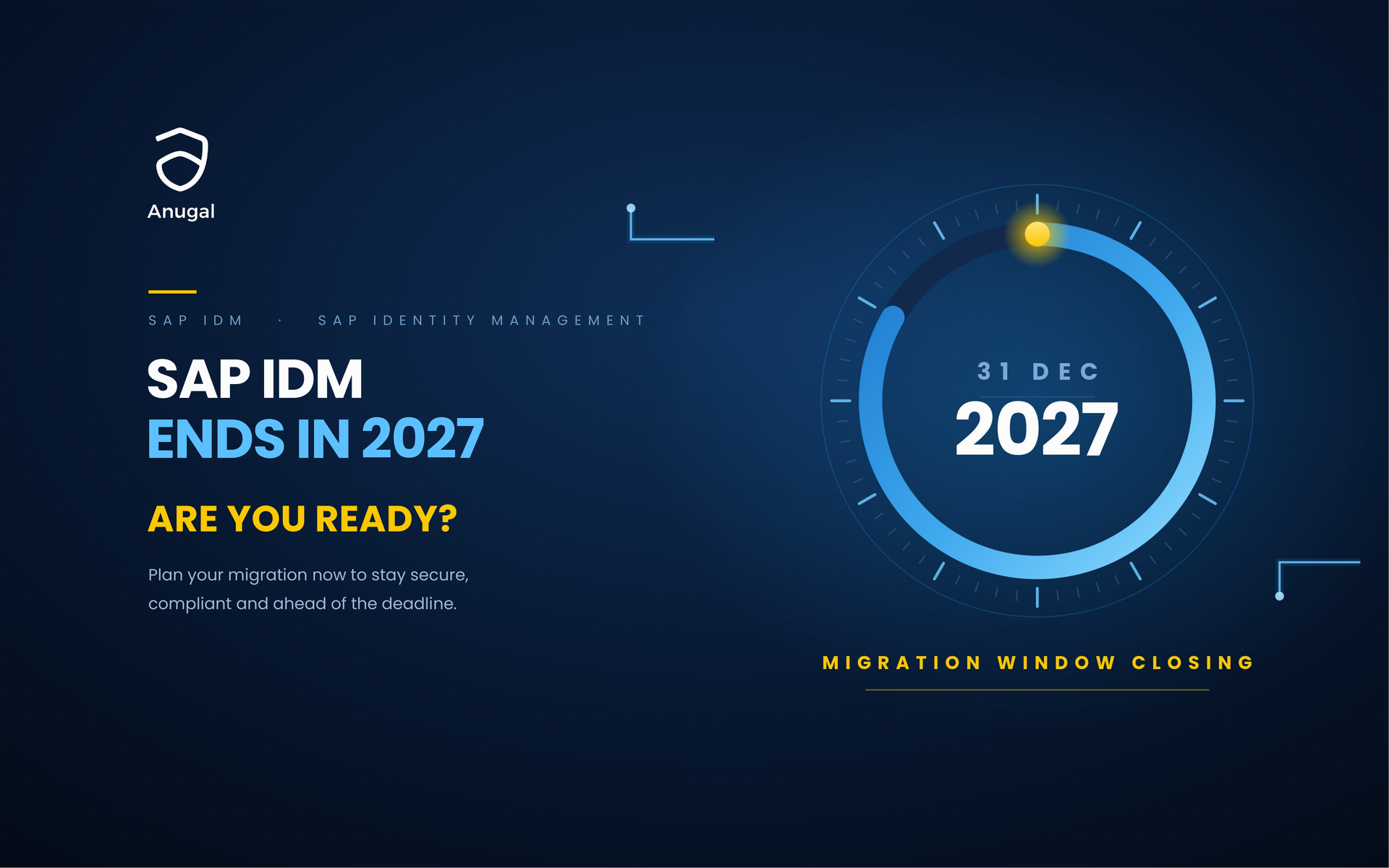
SAP Identity Management has supported identity lifecycle processes in complex enterprise environments for years. But SAP has stated that mainstream maintenance for SAP Identity Management 8.0 runs until the end of 2027, with extended maintenance available until 2030.
That makes the next phase less about replacing one piece of software with another and more about understanding what your current identity environment actually does.
For many enterprises, SAP IDM is connected to HR events, SAP and non-SAP applications, provisioning logic, approvals, custom connectors, roles, audit processes and years of organization-specific decisions. Moving away from it without first mapping those dependencies can simply carry old complexity into a new platform.
A better migration starts with discovery. What must remain? What should be redesigned? What can be replaced? And what should finally be retired?
1. When does SAP IDM maintenance end?
SAP has communicated that mainstream maintenance for SAP Identity Management 8.0 ends at the end of 2027. SAP has also stated that extended maintenance will be available until 2030.
The existence of extended maintenance should not be confused with a migration strategy. It may provide additional time, but the work of understanding integrations, workflows, controls and target architecture still has to happen.
The practical question: How much of your SAP IDM environment is understood well enough today to migrate without disrupting identity lifecycle processes or weakening governance?
2. Why waiting can make the migration harder
SAP IDM environments rarely stand still. Applications change. HR processes evolve. Roles accumulate. Custom integrations remain in place because they still work. Manual exceptions appear around the edges.
The longer this complexity remains undocumented, the harder it can become to distinguish a business-critical control from historical technical debt.
Before selecting a replacement, identify:
- Which systems create or change identity data.
- Which applications receive provisioning from SAP IDM.
- Which workflows and approvals are business-critical.
- Which roles and access rules are still valid.
- Where segregation-of-duties or other risk controls are applied.
- Which custom connectors and scripts have become dependencies.
- Which manual processes exist outside the platform.
- Which audit evidence must remain available after cutover.
3. What should replace SAP IDM?
There is no single answer that fits every SAP IDM environment. The right target depends on the capabilities your organization needs after SAP IDM.
Some organizations may use Microsoft Entra for important parts of their identity architecture. Others may rely on SAP Cloud Identity Services for SAP-focused identity scenarios. Organizations with broader governance requirements may need a full Identity Governance and Administration (IGA) platform, or a combination of services.
SAP describes SAP Cloud Identity Services as a central part of its IAM strategy, particularly for integrating SAP cloud applications and supporting standards-based identity scenarios.
Change the question: Instead of asking “What is the SAP IDM successor?”, ask: “Which identity capabilities do we need, and which platform should own each capability in the future architecture?”
4. Can Microsoft Entra replace SAP IDM?
Microsoft Entra can be an important part of a modern identity architecture, but whether it can replace the responsibilities of a specific SAP IDM environment depends on that environment.
Assess the requirements before deciding:
- SAP and non-SAP provisioning
- Joiner, mover and leaver lifecycle processes
- Role and entitlement governance
- Access requests and approvals
- Access reviews and certifications
- Segregation-of-duties controls
- Custom application integrations
- Audit evidence and reporting
- Non-human and service identities
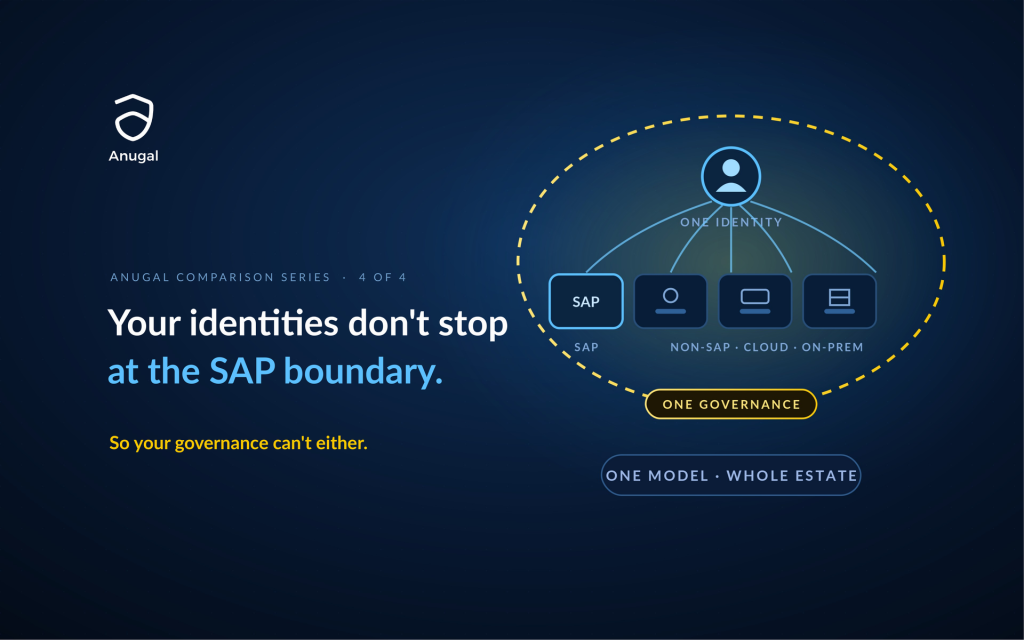
The objective is not to force every capability into one tool. It is to create a target architecture in which ownership, governance and integration are clear.
5. A 7-step SAP IDM migration framework
- Inventory. Map identities, source systems, applications, connectors, roles, workflows, approvals, provisioning processes and dependencies.
- Classify. For each capability, decide whether to retain, redesign, replace or retire it. This prevents old complexity from being copied into the new environment.
- Define requirements. Document the business and governance outcomes the future environment must deliver — not only the technical features of the current system.
- Design the target architecture. Define where lifecycle management, provisioning, governance, risk controls, approvals, integrations and audit evidence will live.
- Migrate in waves. Move in controlled phases rather than treating the entire SAP IDM estate as one cutover. Prioritize dependencies and business impact.
- Validate outcomes. Test access, provisioning, approvals, controls, integrations and evidence. A technically successful migration is not enough if governance is weakened.
- Retire SAP IDM. Complete cutover only after continuity is proven, residual dependencies are addressed and the new governance model is operating as intended.
6. How long does an SAP IDM migration take?
There is no reliable migration duration based only on the number of users. Complexity is driven by the environment.
The timeline is influenced by:
- Number and type of connected applications
- Custom connectors and scripts
- Lifecycle workflows and approval chains
- Role complexity
- SAP and non-SAP dependencies
- Data quality
- Governance and compliance requirements
- Testing and parallel-run requirements
A readiness assessment should therefore happen before a migration timeline is treated as a commitment.
7. The Anugal approach to moving beyond SAP IDM
Anugal approaches SAP IDM transition as a governance transformation rather than a simple product swap.
The process begins by understanding the current state: identities, roles, applications, relationships, workflows and controls. From there, capabilities can be classified, a target architecture can be defined, and migration can proceed in controlled waves.
Anugal can support environment analysis, relationship mapping, risk analysis, governance-gap identification and migration-path assistance. AI-assisted analysis can help teams surface complexity earlier, while governance decisions and approvals remain controlled by the organization.
Anugal migration path: DISCOVER → CLASSIFY → DESIGN → MIGRATE → VALIDATE → CUT OVER → GOVERN
Watch the SAP IDM 2027 migration story
See the SAP IDM deadline, migration challenge and the path beyond legacy identity management without leaving this page.
8. SAP IDM migration readiness checklist
READINESS CHECKLIST
- Identity sources and authoritative systems are documented.
- SAP applications connected to SAP IDM are mapped.
- Non-SAP applications and connectors are mapped.
- Custom scripts, jobs and integrations are identified.
- Joiner, mover and leaver workflows are documented.
- Roles, groups and entitlements have clear ownership.
- Approval chains are understood.
- SoD and other access-risk controls are mapped.
- Access-review and certification requirements are defined.
- Service, technical and non-human identities are included.
- Audit and reporting requirements are documented.
- Capabilities have been classified as retain, redesign, replace or retire.
- A target architecture has been agreed.
- Migration waves and validation criteria are defined.
- Parallel-run and cutover criteria are documented.
9. Frequently asked questions
When does SAP IDM reach end of mainstream maintenance?
SAP has stated that mainstream maintenance for SAP Identity Management 8.0 runs until the end of 2027. Extended maintenance is available until 2030.
What replaces SAP IDM after 2027?
There is no universal one-for-one replacement for every environment. The target should be based on the lifecycle, provisioning, governance, risk, integration and audit capabilities your organization actually needs.
Is SAP Cloud Identity Services the SAP IDM successor?
SAP positions SAP Cloud Identity Services at the center of its IAM strategy. However, organizations should map their existing SAP IDM capabilities and determine which services or platforms are required for their full target architecture.
Can Microsoft Entra replace SAP IDM?
It may cover important capabilities in some environments, but suitability depends on the specific provisioning, governance, SAP integration, access-review, role, risk and audit requirements involved.
What should we assess before migrating from SAP IDM?
Start with identities, source systems, applications, connectors, workflows, approvals, roles, governance controls, custom logic, audit requirements and technical dependencies.
Should we migrate every existing SAP IDM workflow?
Not automatically. Migration is an opportunity to decide what should be retained, redesigned, replaced or retired rather than recreating every historical process.
See where you stand
Your deadline is fixed. Your readiness is measurable.
Take the SAP IDM Readiness Assessment to review your current environment and identify the areas that need attention before migration.
PLAN YOUR SAP IDM TRANSITION
Discuss your current SAP IDM environment, dependencies and migration priorities with the Anugal team.