

DORA for SAP teams · 6 min read
Why DORA Requires Every Third-Party Consultant in SAP to Have Their Own Identity
For financial entities under DORA's full ICT risk management framework, DORA third-party access rules require a unique identity, tied to a unique user account, for every staff member of an ICT third-party service provider who accesses your systems. In SAP, that leaves little room for shared partner support logins. With Anugal, each consultant gets a named identity with a sponsor, a contract end date and a place in every access review.
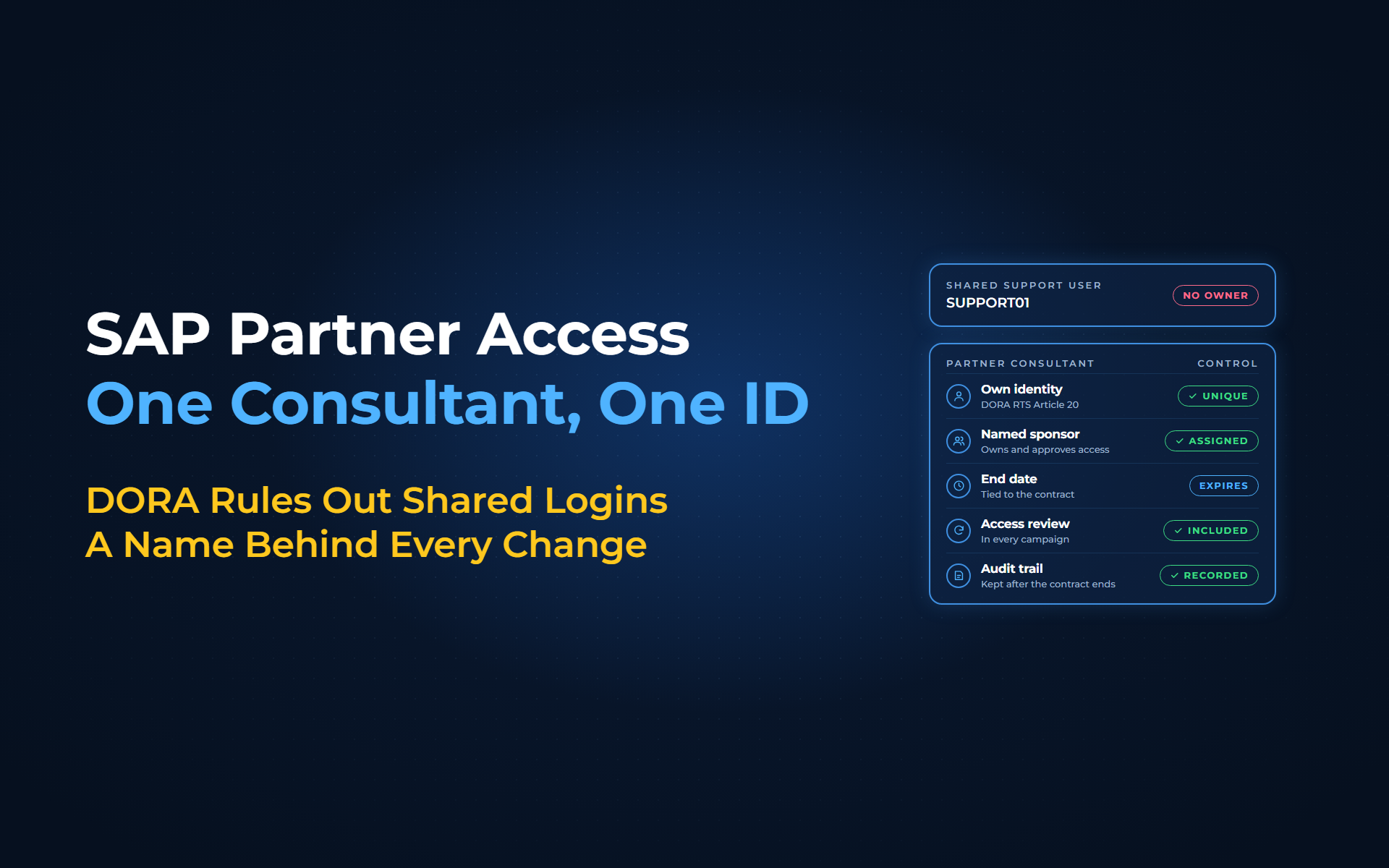
Your SAP support partner has 6 consultants on your account, and all of them sign in to production as one user, SUPPORT01. One evening a payment setting changes, and every log entry shows SUPPORT01. Your auditor asks who made the change, and nobody can answer. With a shared login, the log names a user, not a person.
What do DORA third-party access rules require in SAP?
DORA keeps the responsibility with you, not your partner. It has applied since 17 January 2025, and Article 28(1)(a) says a financial entity using ICT services "shall, at all times, remain fully responsible" for its obligations. Article 20 of the DORA technical standards, Commission Delegated Regulation (EU) 2024/1774, then sets the identity rule:
"a unique identity corresponding to a unique user account shall be assigned to each staff member of the financial entity or staff of the ICT third-party service providers accessing the information assets and ICT assets of the financial entity"
DORA defines an ICT third-party service provider as "an undertaking providing ICT services", which covers an SAP support or application management partner delivering services through your systems. Article 20 also requires a lifecycle process for every account, from creation through review to termination, and records of identity assignments kept after the contract ends. Article 21, point (c), adds that users must be "identifiable for the actions performed in the ICT systems at all times".
Where do SAP partner logins break the rule?
Third-party access is usually granted to meet an immediate need and rarely reassessed when contracts change. In SAP, that leaves 5 gaps:
- Shared support users:
One user for a whole partner team means no action in SAP can be traced to a person. - No named sponsor:
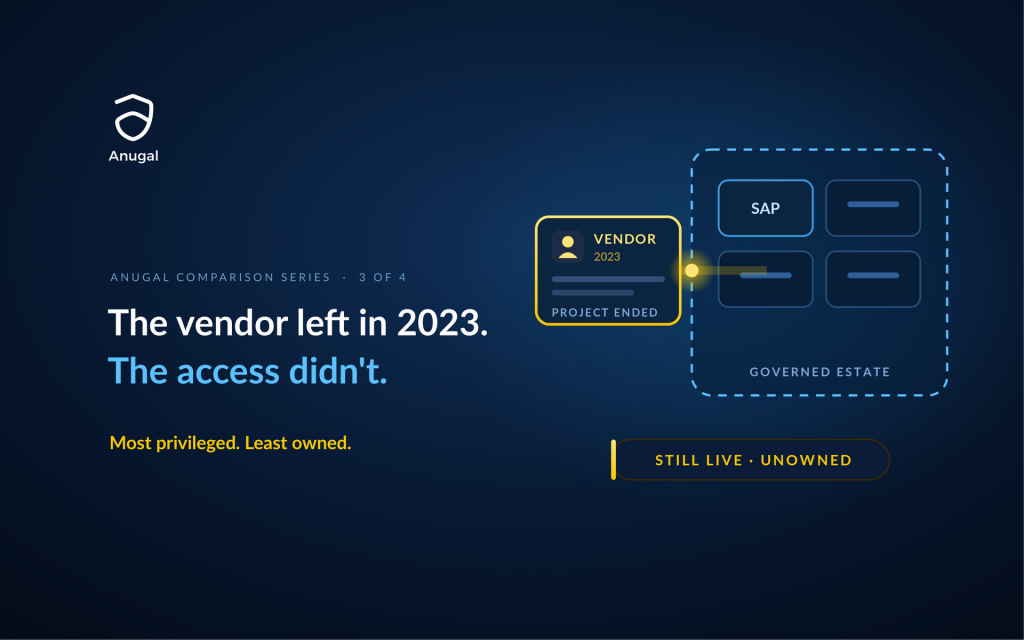
The project that requested the account has closed, and nobody inside your company owns the access. - No end date:
Partner users stay valid after the contract ends or the consultant leaves the partner firm, although the technical standards expect withdrawal without undue delay. - Outside the review:
External users sit outside the HR-driven lifecycle, so they often miss periodic access reviews. - No history after exit:
Nobody records which consultant held which user, so once the contract ends, nobody can say who had access.
How does Anugal give every SAP consultant an accountable identity?
Anugal treats each consultant as a governed third-party identity and connects to SAP through pre-built connectors, so every gap above gets an owner and a control:
- One identity per consultant:
Every vendor, contractor and partner user sits in a single inventory, classified as third party and created from a business purpose and contractual scope. Each consultant works under their own SAP user. - A named sponsor for every user:
Sponsorship is mandatory. Access requests route to accountable business and application owners, and SoD conflicts are checked before anything is provisioned. - An end date tied to the contract:
Access carries start and end dates aligned with the contract, and an extension needs fresh approval and a justification. On the contract end date, Anugal removes the consultant's SAP access automatically, without anyone raising a ticket. - A place in every review:
Third-party identities are included in certification campaigns scoped by application or risk level, with additional scrutiny for privileged external users. - A clean exit with proof:
When the engagement ends, Anugal deprovisions access across connected applications and keeps an audit trail of every approval, provisioning action and revocation, with timestamps and owners.
What changes for a partner consultant in SAP?
Each SAP habit maps to a DORA expectation and an Anugal answer:
| Today in SAP | What DORA expects | With Anugal |
|---|---|---|
| 1 support user shared by a partner team | Unique identity and account per third-party staff member (Article 20) | 1 identity per consultant |
| Access owned by a closed project | Roles for granting, reviewing and revoking access (Article 21) | Mandatory sponsor and owner approvals |
| Users valid after the contract ends | Withdrawal without undue delay (Article 21) | Expiry on the contract end date |
| Partner users missing from reviews | Review within the account lifecycle (Article 20) | Included in certification campaigns |
| No record of who held a user | Identity records kept after the contract (Article 20) | Timestamped audit trail |
Anugal coexists with SAP GRC and your current identity tools. You still decide which partners and systems are in scope, agree on the contract dates, require partners to report consultants who leave early, and own the DORA obligation. With Anugal, every partner identity has an owner and an end date, and the audit trail helps support audit-ready evidence.
See third-party access governed end to end
From 1 shared support login to a name behind every change
Start with the partner users in your production SAP systems. Once each consultant has a personal identity, a sponsor and an end date, every change has a person behind it. To watch a partner consultant onboarded, certified and offboarded in one flow, let's get you a working demo, or write to info.anugal@businesscoresolutions.com.
DORA third-party access: common questions
Does a ticket number count as accountability under DORA?
No. A ticket shows what was requested, not who acted. Article 21, point (c), of the DORA technical standards requires users to be identifiable for the actions performed in ICT systems at all times. If 6 consultants share 1 SAP user, the system records the same user for all of them.
Who counts as an ICT third-party service provider under DORA?
DORA defines an ICT third-party service provider as an undertaking providing ICT services, meaning digital and data services provided through ICT systems on an ongoing basis. SAP support, hosting and application management partners working in your systems fall within that description, and so can SAP's own support staff when they log on to your systems through a support connection.
Can a partner still use a generic SAP account under DORA?
The technical standards ask you to limit generic and shared accounts to the extent possible and to manage generic accounts, including generic administrator accounts, through account management procedures. Where a shared account remains, such as an SAP firefighter ID used through SAP GRC emergency access management, each consultant should log on with their own user first, so every session, reason code and log review traces back to a person.
Do partner consultants need a separate access review under DORA?
DORA sets no separate cycle for them, but they cannot be left out. Article 20 makes review part of the lifecycle of all accounts, and Article 21 requires access rights to be updated at least once a year, or at least every 6 months for ICT systems supporting critical or important functions, so a consultant's SAP user follows the cadence of the system it can reach. Entities on the simplified framework under DORA Article 16 review access periodically instead, under Article 33 of the technical standards.
What happens to third-party identity records when a contract ends?
Article 20 of the DORA technical standards requires financial entities to keep records of all identity assignments after the end of the contractual relationship, subject to Union and national retention rules. Deleting a partner's SAP user without keeping that record leaves no reliable link between the user ID in old logs and the person who held it.
Sources
- Commission Delegated Regulation (EU) 2024/1774 (DORA RTS on ICT risk management), Publications Office of the EU (https://publications.europa.eu/resource/celex/32024R1774). Article 20: unique identity and user account for staff of ICT third-party service providers, account lifecycle and retention of identity assignment records; Article 21, points (c), (e), (e)(i), (e)(iii) and (e)(iv): user accountability, generic accounts, roles for granting and revoking, withdrawal without undue delay and review cycles; Title III, Article 33: periodic access review for entities on the simplified ICT risk management framework (DORA Article 16).
- Regulation (EU) 2022/2554 (DORA), Publications Office of the EU (https://publications.europa.eu/resource/celex/32022R2554). Article 3, points (19) and (21): definitions of ICT third-party service provider and ICT services; Article 28(1)(a): the financial entity remains fully responsible; Article 64: application from 17 January 2025.
- Anugal: Third-Party Identity Governance (https://anugal.ai/third-party-identity-governance/). Single inventory, third-party classification, purpose-based creation, mandatory sponsorship, owner-routed approvals with SoD checks, contract-aligned expiry, re-approval for extensions, extra scrutiny for privileged external users, offboarding and recorded evidence.
- Anugal: Manage Machine and Third-Party Access (https://anugal.ai/manage-machine-third-party-access/). Third-party identities outside HR-driven lifecycle controls and periodic certification; third-party identities included in certification and audit cycles.
- Anugal: Access Certifications (https://anugal.ai/access-certifications/). Campaigns scoped by role, application, entitlement type or risk level.
- Anugal: Reports and Audit Trails (https://anugal.ai/reports-audit-trails/). Append-only audit records with timestamps and actors.
- Anugal: FAQs (https://anugal.ai/faqs/). Pre-built connectors for SAP; coexistence with current tools such as SAP GRC.