

ANUGAL COMPARISON SERIES · 4 OF 4 · CATEGORY WIN
Hybrid Identity Governance: Why SAP-Only Security Leaves Gaps
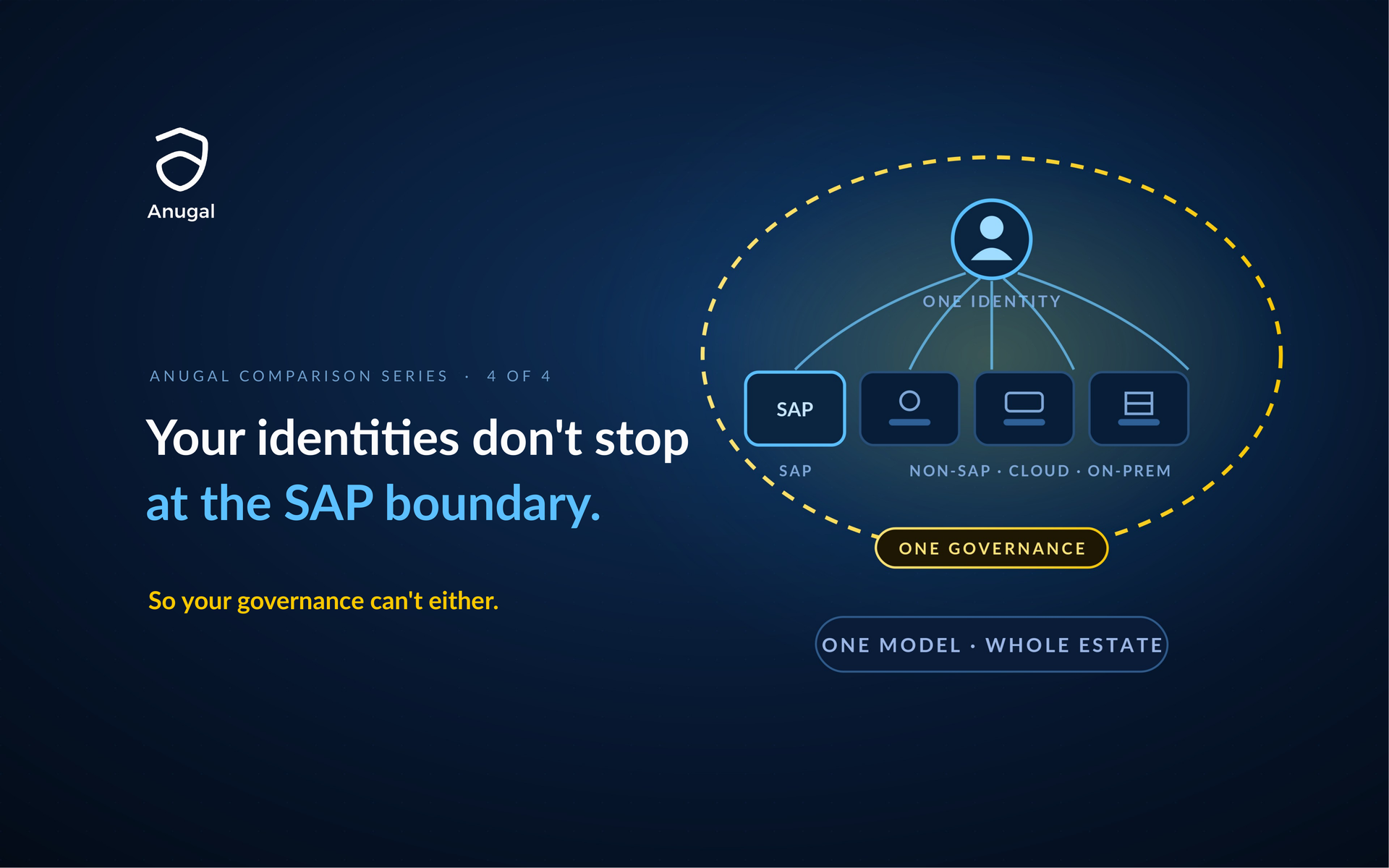
Your finance team lives in SAP. But they also use Salesforce, a cloud HR platform, a data warehouse, and a dozen SaaS tools that touch sensitive data. An SAP-only security tool governs one of those and cannot see the rest. The identities are the same people; the governance stops at the SAP boundary. That gap is where hybrid identity governance earns its name.
THE SHORT ANSWER
Hybrid identity governance manages access across SAP and non-SAP systems, cloud and on-premise, from one place. It matters because identities and their risks span the whole estate, while SAP-only tools govern only the SAP slice. One person's toxic access combination can span SAP and a non-SAP app, invisible to any single-system tool.
Why 2026 widens the boundary. AI agents and copilots now reach across enterprise systems through standard connectors, holding access that crosses the SAP boundary the same way your people do. Governing that access from inside SAP alone was already incomplete for hybrid human identities; for cross-system agents it is impossible. The estate the identity layer has to see keeps growing outward, which is the whole argument for governance that does not stop at SAP.
Why SAP-only governance leaves a gap
Because risk does not respect application boundaries. A segregation-of-duties conflict can span two systems: create a vendor in SAP, approve the payment in a separate finance app. Governed inside SAP alone, that conflict is invisible, because half of it lives elsewhere. The same is true of joiners who need access to eight systems on day one, movers who should lose access in five, and leavers whose accounts must close everywhere at once.
Look at the market position. Among Anugal, SecurityBridge, Saterion, and Onapsis, non-SAP application support is native in one, absent in two that are SAP-only, and partial in Onapsis, which adds Oracle. If your estate is purely SAP, that is fine. Almost none are.
Your identities do not stop at the SAP boundary, so your governance cannot either.
What hybrid governance covers
| Capability | What it means across a hybrid estate |
|---|---|
| One access model | RBAC and policies applied consistently across SAP and non-SAP, not reinvented per system |
| Cross-system SoD | Toxic combinations detected even when the conflicting access spans two different applications |
| Unified joiner-mover-leaver | One lifecycle grants and revokes across every connected system at once |
| Single certification campaign | Reviewers see a user's full access in one place, not one review per application |
| One audit record | Evidence spans the estate, so the auditor gets one story, not a stack of exports |
The value of hybrid governance is the view no single-system tool can give: the whole identity, at once.
The Hybrid Coverage Checklist: 5 questions
THE HYBRID COVERAGE CHECKLIST
- Can you see one user's complete access across SAP and non-SAP in a single view?
- Would a segregation-of-duties conflict spanning two systems surface anywhere today?
- Does one leaver process close accounts across every connected application?
- Do your certifications review a user's whole access, or one system at a time?
- Is your audit evidence one record, or a pile of per-system exports?
A no to two or more means the governance gap is already open, and it sits outside SAP where your SAP tools cannot look.
Mistakes that keep the gap open
- Governing SAP well and everything else informally. The non-SAP estate holds sensitive data too; informal governance there is an audit finding waiting to happen.
- Running one certification per system. Per-system reviews never show the whole user, so cross-system risk slips through every campaign.
- Stitching hybrid governance together by hand. Manual reconciliation across systems is slow, error-prone, and impossible to evidence cleanly. Connect the systems instead.
Frequently asked questions
What is hybrid identity governance?
Governance of access across both SAP and non-SAP systems, cloud and on-premise, from a single platform. It applies one access model, cross-system SoD, unified lifecycle, and consolidated certification and audit, so a user's whole access is governed together rather than one system at a time.
Why not just use an SAP security tool?
Because SAP-only tools govern only the SAP slice of identity. Risks that span SAP and non-SAP, cross-system SoD conflicts, movers, leavers, stay partly invisible. For a hybrid estate, governance needs to reach every system the identity touches, which is what hybrid IGA provides.
Does hybrid governance replace my SAP security tools?
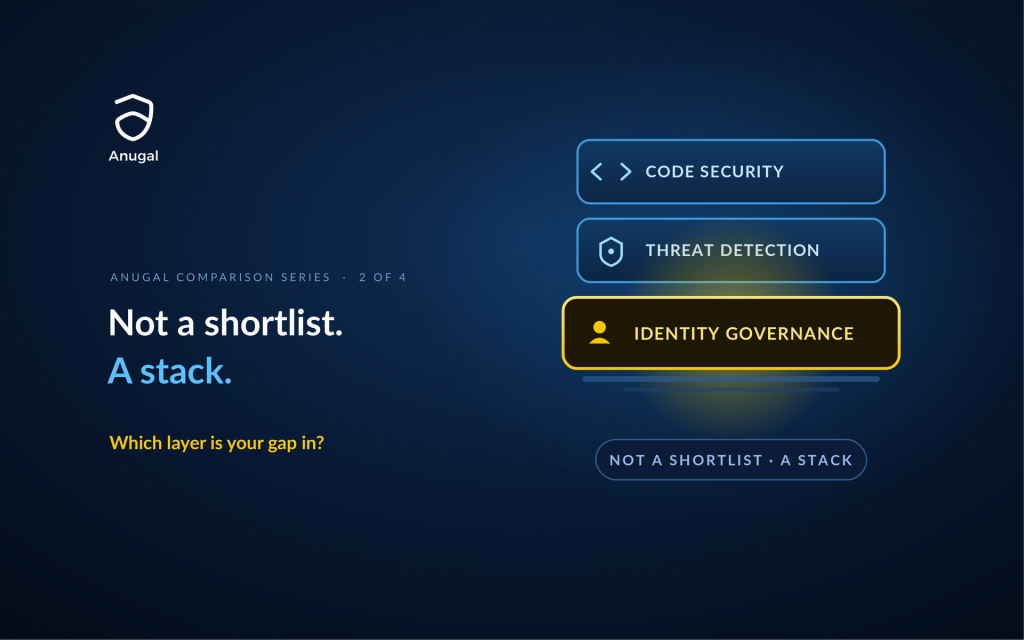
No. It governs identity across the whole estate and sits alongside SAP threat detection and vulnerability tools like SecurityBridge and Onapsis, which defend the SAP system itself. Governance and defense are different layers; a strong posture runs both.
How Anugal solves it
Hybrid reach is the second clear single-column win in the comparison, and it is core to what Anugal is.
WHERE ANUGAL IS THE RIGHT CHOICE
- Native SAP and non-SAP support. Cloud and on-premise applications governed from one platform, where SecurityBridge and Saterion are SAP-only and Onapsis adds Oracle.
- Cross-system SoD. Toxic combinations detected even when the conflict spans SAP and a non-SAP app, the risk single-system tools cannot see.
- One lifecycle, one certification, one record. Joiner-mover-leaver, recertification, and audit evidence unified across the estate.
- Aligned to modern frameworks. Governance mapped to ISO 27001, SOC 2, NIS2, and CSCRF across the whole estate, not just SAP.
- Complements, not replaces. Runs beside SAP GRC and your SAP security tools, extending governance past the SAP boundary.
If every identity and system you care about lives inside SAP, an SAP-focused tool may serve you well. The moment governance needs to cross into non-SAP, that is where Anugal fits.
About Anugal. Anugal is the Agentic Identity Governance and Administration platform from Business Core Solutions (BCS). It unifies identity lifecycle, access requests, certifications, vendor access, and risk governance across SAP and non-SAP systems, with 350+ integrations and a Microsoft Teams-native experience.
MAP IT TO YOUR ESTATE
Bring your current SAP and non-SAP security stack and we will map exactly where Anugal fits alongside it, and where it does not. An honest 30-minute walkthrough, no slideware.
That completes this comparison series. Start from the full comparison: Anugal vs SecurityBridge, Saterion and Onapsis.