

ANUGAL COMPARISON SERIES · 3 OF 4 · CATEGORY WIN
Vendor Access Management: The Capability SAP Security Tools Skip
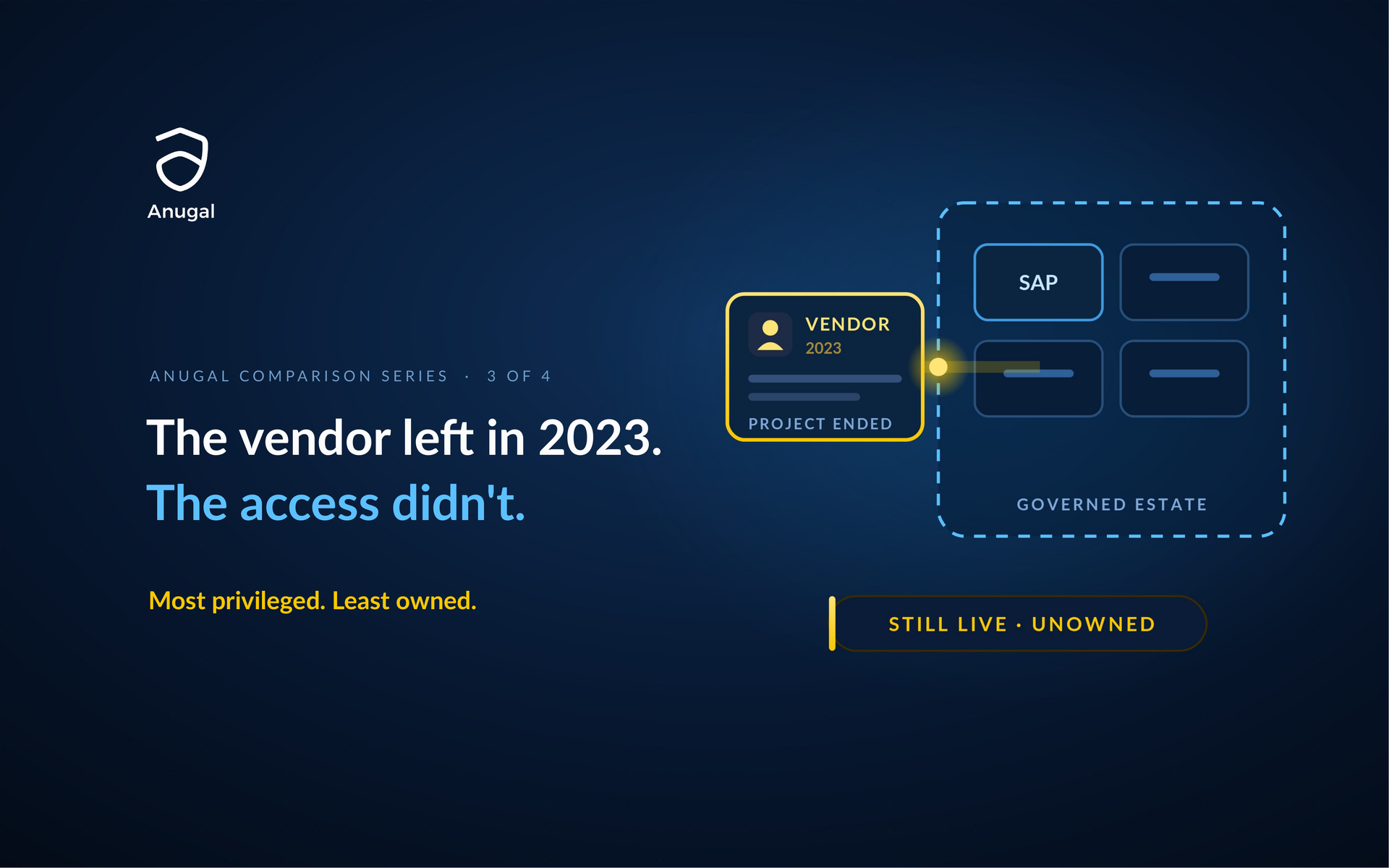
A vendor was given SAP access for a 2023 implementation project. The project ended. The consultant moved on. The access did not. Two years later it is still live, still privileged, and owned by nobody, because the person who approved it left too. This is the risk most SAP security tools cannot even see, because they were never built to manage vendor identities.
THE SHORT ANSWER
Vendor access management governs the full lifecycle of external identities: contractors, consultants, and partners who need access to your systems. Most SAP security tools do not address it at all. The gap matters because third-party access is often the most privileged, longest-lived, and least-governed access in the estate, and a frequent breach path.
Why is vendor access the riskiest access?
Because it combines high privilege with low ownership. Vendors often get broad access to get a job done fast. They sit outside HR, so no joiner-mover-leaver process tracks them. Their access outlives projects, changes hands informally, and rarely gets recertified. With 90 percent of large organizations reporting an identity-related incident in the past year, per the Identity Defined Security Alliance's 2024 study, third-party identities are a recurring route in.
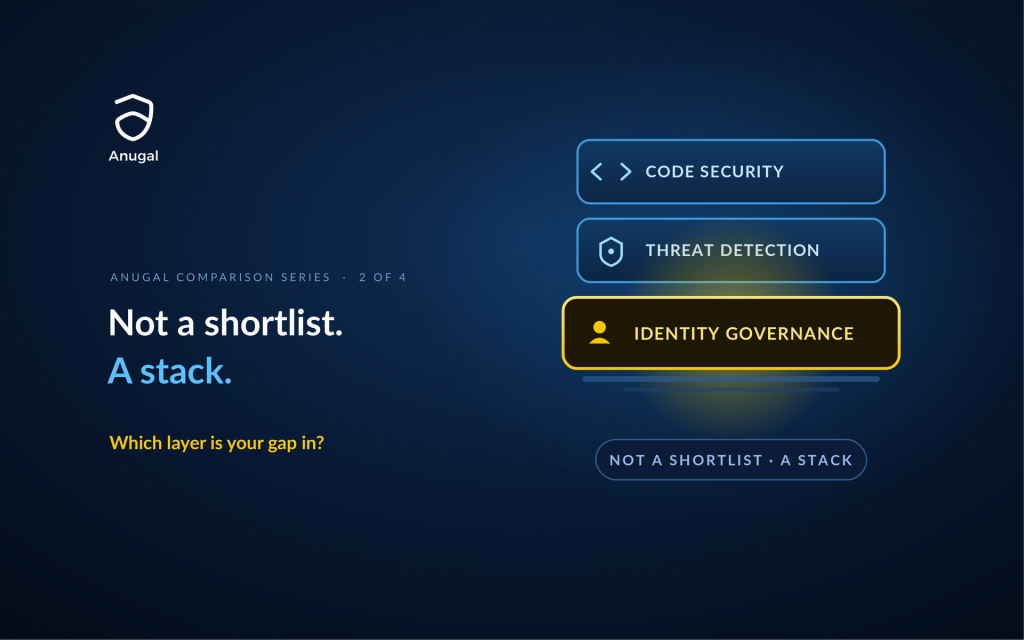
Now look at where the market leaves this. In a side-by-side of Anugal, SecurityBridge, Saterion, and Onapsis, vendor access management is supported by one of the four. The other three do not address it. This is not a knock on those tools; threat detection and code scanning are different jobs. It is a gap in most estates that nobody staffed a tool against.
Third-party access is the most privileged, longest-lived, least-owned access you have.
And the population is about to widen. The 2026 identity story is non-human identities outnumbering human ones: not just vendor logins now, but the service accounts and AI agents that vendors and integrations bring with them. The same weakness applies, with less oversight: high privilege, informal ownership, no lifecycle. A tool that governs external human identities well is the natural home for governing these too, which makes the vendor-access gap more urgent, not less.
What a governed vendor lifecycle looks like
Governing external identities is the same discipline as internal joiner-mover-leaver, adapted to people who are not employees. Six controls define it.
- Onboard against a contract. Vendor identity is created with a scope and an end date tied to the engagement, not an open-ended account.
- Map a single point of contact. Every vendor identity has an internal owner who answers for it, so it never belongs to nobody.
- Grant least privilege. Access is scoped to the work, with SoD checked exactly as it is for employees.
- Time-box by default. Access expires with the contract; extensions are decisions, not drift.
- Certify on a separate cycle. Vendor access gets its own recertification, because its risk profile differs from employees.
- Deprovision on exit. Contract end triggers removal automatically, closing the 2023-account problem for good.
Govern the vendor like an employee who was never in your HR system, because that is exactly what they are.
The Vendor Access Checklist: 6 controls for every external identity
THE VENDOR ACCESS CHECKLIST
- A contract-bound scope and end date on every vendor account.
- A named internal owner (single point of contact) for each vendor identity.
- Least-privilege access with SoD checked, same as employees.
- Time-boxed access that expires with the engagement.
- A separate recertification cycle for external identities.
- Automatic deprovisioning triggered by contract end.
Mistakes that leave vendor access ungoverned
- Managing vendors in the same flow as employees. Vendors sit outside HR, so an HR-triggered lifecycle never fires for them. They need their own path.
- Assuming your SAP security tool covers it. Threat detection may watch a vendor's behavior, but watching is not governing. Most tools do not manage the identity at all.
- Relying on project managers to remember offboarding. Manual offboarding is where the 2023 account came from. Tie removal to the contract, not to memory.
Frequently asked questions
What is vendor access management?
The governance of external identities, contractors, consultants, and partners, across their full lifecycle: onboarding against a contract, least-privilege access, time-boxing, recertification, and deprovisioning at exit. It applies employee-grade governance to people who sit outside your HR system.
Do SAP security tools manage vendor identities?
Mostly no. In a comparison of Anugal, SecurityBridge, Saterion, and Onapsis, only Anugal provides a full vendor-access lifecycle. The others focus on threat detection, vulnerability, or SAP authorization, and do not manage external identities as a governed lifecycle.
Why is third-party access a security risk?
It tends to be highly privileged, long-lived, and poorly owned. Vendors get broad access quickly, sit outside employee lifecycle processes, and keep access after projects end. That combination makes third-party identities a common and attractive path for attackers.
How Anugal solves it
Vendor access management is the clearest single-column win in the whole comparison, and it is native to Anugal.
WHERE ANUGAL IS THE RIGHT CHOICE
- Full vendor lifecycle. Onboarding, contract-based access, SPOC mapping, and deprovisioning workflows for external identities, end to end.
- Separate certification cycles. Vendor access is recertified on its own schedule, with audit evidence, apart from internal reviews.
- SoD and least privilege for outsiders. External identities get the same risk controls as employees, so a vendor cannot hold a toxic combination either.
- A column the others leave empty. SecurityBridge, Saterion, and Onapsis do not provide vendor access management; this is governance they were not built for.
- Governed in Teams. Vendor requests and approvals run through the same Teams-native workflow as the rest of your access.
If your biggest exposure is a vulnerable SAP system rather than vendor sprawl, start with a security-layer tool. But if forgotten vendor accounts keep you up at night, this is the gap Anugal was built to close.
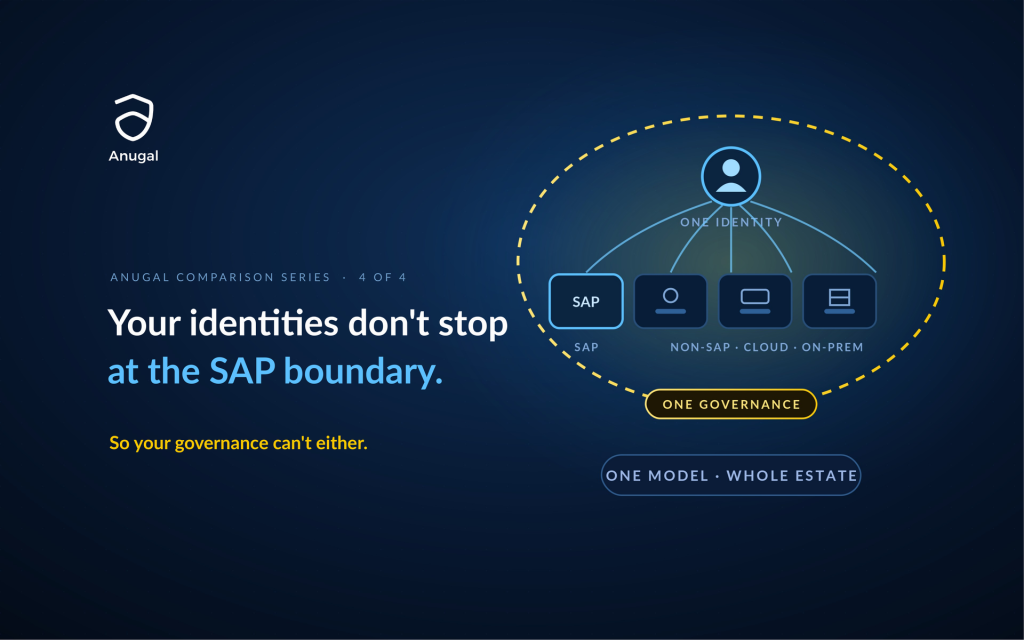
About Anugal. Anugal is the Agentic Identity Governance and Administration platform from Business Core Solutions (BCS). It unifies identity lifecycle, access requests, certifications, vendor access, and risk governance across SAP and non-SAP systems, with 350+ integrations and a Microsoft Teams-native experience.
MAP IT TO YOUR ESTATE
Bring your current SAP and non-SAP security stack and we will map exactly where Anugal fits alongside it, and where it does not. An honest 30-minute walkthrough, no slideware.
Next in this series is live: Hybrid Identity Governance: Why SAP-Only Security Leaves Gaps