
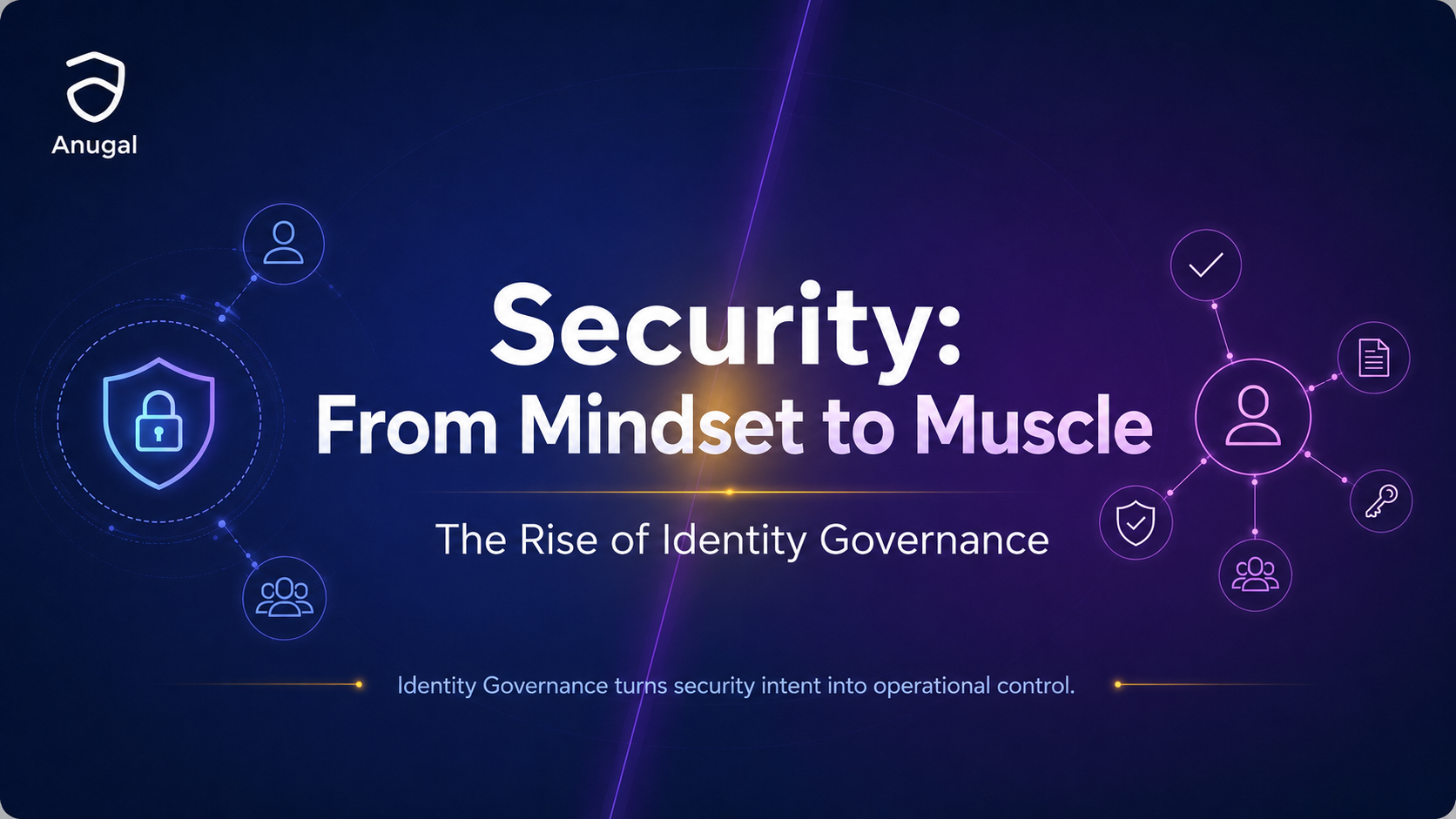

Security: From Mindset to Muscle — The Rise of Identity Governance
Security starts as a mindset. But believing in security is one thing. Enforcing it consistently, at scale, every day is something else entirely.
Security cannot simply be added at the end of a project or treated as an afterthought. The real challenge is turning that belief into controls that operate continuously across the organisation.
And this is where many organisations quietly struggle.
IAM without governance is just faster risk
Most enterprises today can confidently say:
- SSO is implemented.
- MFA is enabled.
- Users are provisioned automatically.
- Access requests are digitised.
On paper, identity may look complete.
Yet organisations still face access-related audit findings, excessive permissions, and insider risk that builds quietly over time.
Why?
IAM without governance does not automatically reduce access risk. It may simply make provisioning faster without answering whether the resulting access remains appropriate.
SSO and MFA are essential — but they are only the first layer
A common pattern appears after organisations successfully deploy Single Sign-On and Multi-Factor Authentication.
There is a natural sense that identity security is now covered.
That confidence is understandable. SSO and MFA provide important security value. They are foundational identity controls.
But they solve only part of the problem.
What SSO does well
- Reduces password sprawl and credential fatigue.
- Improves user experience and productivity.
- Centralises authentication across applications.
What MFA does well
- Protects against stolen or weak credentials.
- Reduces account takeover risk.
- Strengthens trust at the moment of login.
That is a vital checkpoint. But it is only the first checkpoint in an effective identity security strategy.
What SSO and MFA do not answer
SSO and MFA primarily address authentication.
They do not continuously determine whether every permission behind that login is still justified.
The unanswered questions are governance questions:
- Should this user still have access to this system?
- Is the access excessive for their role?
- Does this access violate Segregation of Duties?
- Was this access ever reviewed?
- Was it removed when the role changed?
These unanswered questions are where identity risk begins to accumulate.
Authentication and governance solve different problems
| Control | Main Question | Primary Focus |
|---|---|---|
| SSO | How does the user authenticate across applications? | Authentication experience and credential management |
| MFA | Can the user prove their identity with additional assurance? | Login security and account takeover protection |
| IGA | Should this user have this access, and should they still have it today? | Access decisions, policy, risk, lifecycle, and accountability |
Identity Governance is where security becomes operational
Security maturity is not achieved simply by adding more tools.
It comes from making better access decisions consistently, transparently, and throughout the identity lifecycle.
This is where Identity Governance and Administration begins.
Access Justification
Understand why a user needs a particular role, application, or entitlement before the access is granted or retained.
Policy Enforcement
Use defined policies and business context to shape how access decisions are made.
Segregation of Duties
Identify combinations of access that create unacceptable business or compliance risk.
Access Certifications
Validate whether existing access still matches the user's current responsibilities and business need.
Platforms such as Anugal help translate identity governance principles into operational processes across access requests, policy, risk controls, certifications, and lifecycle management.
What does a mature Identity Governance model look like?
In a mature Identity Governance model:
- Every access decision has a clear business justification.
- Policies guide access instead of disconnected tickets or emails.
- Access is validated throughout its lifecycle.
- Risk is addressed before it becomes an audit finding.
This changes the role identity plays inside the organisation.
Identity as Plumbing
Identity is treated mainly as provisioning, authentication, and technical infrastructure.
Identity as Control Fabric
Access decisions connect with policy, business context, lifecycle, and risk.
Identity as Security Muscle
Governance operates continuously and turns security intent into repeatable action.
The Identity-First Mindset: How organisations must rethink identity
Believing that identity is critical does not reduce risk by itself.
Risk is reduced when that belief is operationalised, enforced, and continuously validated.
This is where identity moves from intent to muscle.
Identity-first organisations build identity directly into the way the business operates.
1. Identity belongs to the business — not just IT
The first shift is to stop treating identity as only an IT-owned system and start treating it as a business control layer.
Access decisions are business decisions with risk, compliance, operational, and financial consequences.
That is why identity should connect with:
- HR systems that define Joiner-Mover-Leaver events.
- ITSM platforms that support requests, approvals, and exceptions.
- Business applications where ownership and accountability live.
2. Access is about context — not convenience
Traditional access management often asks:
Identity-first governance asks:
That context includes:
- Who the user is.
- Their role, department, and location.
- The sensitivity of the system or data.
- Segregation-of-duties risks.
- Whether access is temporary or permanent.
Anugal brings policy and governance context into access decision-making so tickets do not become the decision engine.
3. Security must be continuous — not event-driven
Access that was valid six months ago may be risky today.
Identity Governance therefore cannot depend only on occasional review campaigns or audit-driven clean-up.
The organisation needs to keep asking:
Continuous governance supports:
- Continuous access certifications.
- Visibility into privilege and entitlement changes.
- Revocation when the conditions supporting access change.
4. Move from visibility to enforcement
Traditional IAM provides important visibility:
- Who logged in?
- Who was provisioned?
Identity Governance goes further:
- Who should have access?
- Why do they have it?
- Is it still justified?
- Does it comply with policy?
Anugal supports this transition by connecting access decisions with governance context and evidence.
Identity Governance is security's muscle
Mindset defines intent.
Muscle delivers outcomes.
| Without Identity Governance | With Identity Governance |
|---|---|
| Security beliefs remain theoretical. | Access decisions are actively enforced. |
| Risk accumulates quietly over time. | Risk is identified and addressed throughout the lifecycle. |
| Access depends heavily on tickets, emails, and manual follow-up. | Policies and governance context shape access decisions. |
| Audits expose gaps after they already exist. | Evidence is created as part of the governance process. |
Why auditors care about governance, not just login success
Auditors and regulators do not stop with:
They also need to understand the governance behind the access.
They ask:
- Why does this user have access?
- Who approved it?
- Was it reviewed?
- Was it removed on time?
- Can you prove it?
Without governance, those answers often live in:
- Emails
- Spreadsheets
- Tickets
- Informal organisational knowledge
That turns audit preparation into a reconstruction exercise.
With governed identity processes, requests, approvals, reviews, changes, and removals become part of a traceable decision history.
Why Anugal fits
Anugal helps organisations move beyond authentication and operationalise Identity Governance and Administration across the access lifecycle.
Policy-Driven Access
Access decisions incorporate policy, business context, risk, and governance requirements instead of relying only on manual tickets.
Joiner-Mover-Leaver Governance
Identity changes follow business events, helping access remain aligned with current responsibilities.
Segregation of Duties
SoD controls help identify inappropriate combinations of access before they become embedded in the environment.
Access Certifications
Review processes help organisations validate whether existing access still matches the user's current business need.
Traceable Decisions
Requests, approvals, reviews, changes, and access decisions form part of an auditable governance history.
Continuous Governance
Identity Governance becomes an ongoing operating discipline rather than an activity triggered only by an audit.
From security belief to security execution
Security starts with the belief that access should be protected, controlled, and accountable.
But belief alone does not revoke stale access.
It does not prevent toxic access combinations.
It does not prove who approved a role.
And it does not tell an auditor why someone still holds a permission.
Identity Governance closes that gap between security intent and operational execution.
Frequently Asked Questions about Identity Governance
Why are SSO and MFA not enough for identity security?
SSO and MFA strengthen authentication and help confirm that the correct user is logging in securely. They do not determine whether every role or entitlement the user holds is still appropriate. Identity Governance addresses that ongoing access question.
What is Identity Governance and Administration?
Identity Governance and Administration helps organisations govern who should receive access, why the access exists, how it is approved, whether it creates risk, and whether it should remain in place over time.
What is the difference between IAM and IGA?
IAM covers identity and access capabilities such as authentication, provisioning, and access management. IGA adds governance around access justification, policy, lifecycle controls, certifications, Segregation of Duties, and accountability.
Why is access certification important?
Access certification helps organisations confirm whether existing access still matches a user's current role and business need. This becomes especially important as employees change responsibilities and permissions accumulate over time.
What does an identity-first security model mean?
An identity-first model treats identity as a business control layer. Access decisions connect to business context, policy, lifecycle events, risk, and accountability rather than being treated only as technical IT tasks.
How does Anugal support Identity Governance?
Anugal brings together access governance, Joiner-Mover-Leaver lifecycle processes, policy-driven decisions, Segregation of Duties, access certifications, and traceable access evidence within a broader IGA model.
Ready to turn identity security into operational muscle?
Bring access decisions, lifecycle governance, policy, risk controls, certifications, and audit evidence into one governed identity model with Anugal.
Reach us at hello@businesscoresolutions.com