

Why Employee Role Changes Create Hidden Access Risk
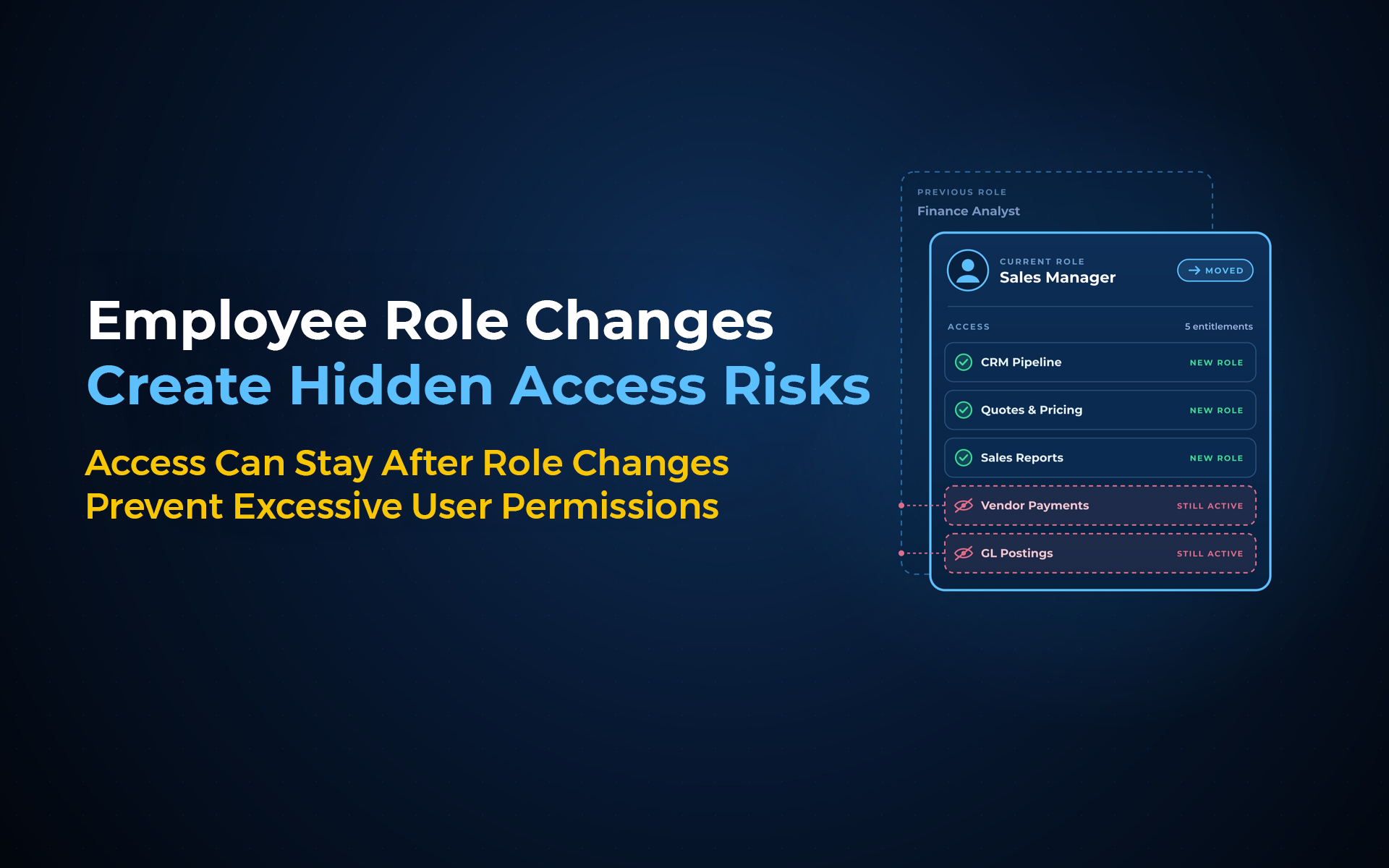
One promotion can create two access profiles: the job a person has now and the job the systems still remember.
That difference is where hidden mover risk begins.
Employee role changes create hidden access risk when new permissions are added but old permissions remain. The employee may still hold access tied to a previous department, location or responsibility. A governed mover process should recalculate access from current role data, remove outdated entitlements, add justified access and record the full change.
The risk starts with 1 ordinary internal move
Movers are easy to miss because the person never leaves the company.
Consider Elena, who moves from operations into finance. Her manager asks for the finance access she needs. The request gets approved. She starts the new role.
The hidden question comes later: who removed the operations access?
If the answer is 'someone will review it later,' the company now carries access from two employment contexts. The person may have legitimate finance access and outdated operations access at the same time.
4 ways old access survives a role change
Access accumulation is not one mistake. It usually comes from several small process gaps.
- The new manager requests additions but no one owns removals.
- The old department does not receive a mover notification.
- The IAM process updates directory groups but misses application-level or privileged access.
- A review happens later, after the person has already carried outdated access for a period of time.
This is why mover risk often looks harmless in isolation. Each permission may have been approved at some point. The problem is that the approvals belong to different points in the employee's history.
Europe makes the employment-change link explicit in 1 access rule
For covered entities, European cyber rules now connect access-right changes directly to employment changes.
Commission Implementing Regulation (EU) 2024/2690 states that relevant entities should provide, modify, remove and document access rights. It also states that access rights should be modified when employment terminates or changes, using need-to-know, least privilege and separation of duties.
That is a useful operational benchmark even outside the regulation's scope. A role change is not complete when the new access is live. It is complete when the old access has also been evaluated.
India and Australia: 2 reasons current workforce data matters
Mover governance depends on current identity data, not the employee's historical profile.
India's Digital Personal Data Protection Rules, 2025 were notified on 14 November 2025. As organisations review data flows under the DPDP framework, identity teams should also check whether HR changes reach downstream access decisions quickly and accurately.
Australia's OAIC guidance stresses information quality and security within the 13 Australian Privacy Principles. A stale role or location in an identity process creates a practical data-quality problem because the access decision no longer reflects the current employee context.
The 4-check Mover Risk Review
Use the Mover Risk Review every time a meaningful role, department or location change occurs.
- Current role: what access does the new responsibility require?
- Old role: what access only existed because of the previous responsibility?
- Conflict check: does the combined access create a policy or separation-of-duties issue?
- Execution proof: did each removal and addition reach the target system and get recorded?
A mover is not a new access request. A mover is an access recalculation.
4 mistakes that hide mover risk
The biggest mover mistake is treating additions as urgent and removals as optional.
- Waiting for the next certification campaign to find obviously outdated access.
- Keeping old access "for convenience" without an owner, reason or end date.
- Updating only core directories while ignoring business applications.
- Using job title alone when department, location or responsibility also affects access.
Where Anugal fits
Anugal connects HR-driven joiner, mover and leaver events with governed identity actions. The workflow evaluates the workforce context and policy before access is created, changed or revoked, and records the lifecycle action.
That keeps the process practical: start with the workforce event, define the access decision, send the approved change to the target system, and retain evidence of what happened.
Frequently asked questions
What is access creep?
Access creep is the gradual accumulation of permissions that a person no longer needs. Internal role changes are a common cause because the new role adds access while the old role permissions remain.
Why are movers harder than joiners or leavers?
The identity stays active, so there is no natural stop point. The workflow must compare the old context with the new one and decide what to keep, remove and add.
Should all old access be removed immediately?
Remove access that no longer has a valid business need. If a transition period is required, define the exception, owner and end date rather than leaving the old access open indefinitely.
How often should mover access be reviewed?
The most useful review happens at the employment change itself. Periodic certification remains valuable, but it should not be the first time your organisation notices a known role change.
How does Anugal approach mover automation?
Anugal states that it recalculates access when roles, departments or locations change, removes excess and legacy entitlements, provisions new access and records the change.
Next step
See how Anugal approaches mover governance and access recalculation.
Prefer a direct conversation? hello@businesscoresolutions.com