

Automated Access Revocation: Why Removing Access Matters as Much as Granting It
Every access grant creates a future question: what event will remove it? If you cannot answer that question, the permission has no clear end condition.
Automated access revocation gives access decisions a closing action.
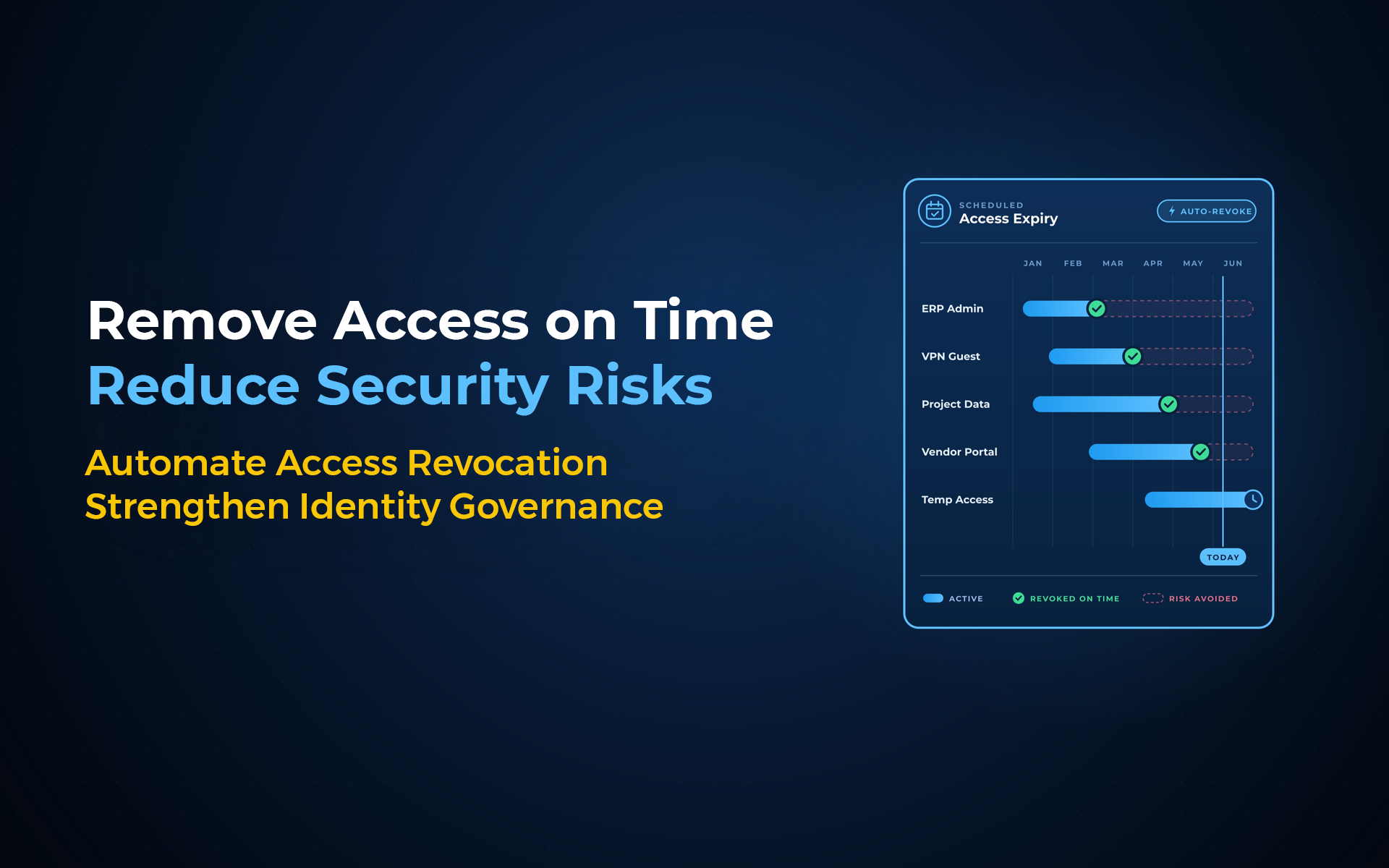
Automated access revocation removes permissions when a defined business event makes them unnecessary or invalid. Common triggers include termination, role change, contract expiry and a policy or review decision. A good revocation flow identifies the trigger, finds the affected access, executes the removal, handles approved exceptions and records proof that the target system completed the change.
Every grant needs 1 removal condition
Access governance is incomplete when you define how access starts but not how it ends.
Consider a contractor who receives access for a six-month project. The access is valid on day one. It may still be valid in month five. On the day the contract ends, the same permission becomes a risk if nothing removes it.
The same logic applies to a permanent employee who changes roles or leaves. Access does not become wrong because the original approval was bad. It becomes wrong because the business context changed.
The 4 revocation triggers to design first
Start with four trigger types: termination, role change, expiry and policy decision.
- Termination: employment or engagement ends, so access tied to that relationship should close.
- Role change: the person stays, but access tied only to the old responsibility should be removed.
- Contract or time expiry: temporary access reaches its approved end date.
- Policy or review decision: an owner or governance process decides that access no longer has a valid need.
These triggers cover different situations, but the control principle is the same. The trigger should lead to an executable removal action, not only a notification.
Europe gives 6 concrete access-right expectations
For covered entities, EU rules now spell out access-right management in operational terms.
Commission Implementing Regulation (EU) 2024/2690 lists six expectations in section 11.2.2: use need-to-know, least privilege and separation of duties; change access when employment changes or ends; require authorisation; limit third-party access in scope and duration; maintain a register of granted rights; and log access-right management.
That list is useful because revocation is not isolated from the rest of governance. It depends on ownership, duration, records and execution.
The US zero-trust model adds 4 maturity stages
CISA's model shows why event-driven revocation fits modern identity operations.
CISA describes four zero-trust maturity stages. The Traditional stage includes manually configured lifecycles and static least privilege. The higher stages add automation, policy enforcement and, at the Optimal stage, automated just-in-time lifecycles driven by triggers.
For revocation, the practical move is clear: when you already know the end condition, build the removal into the lifecycle instead of waiting for someone to remember it.
The 4-trigger Revocation Matrix
Use the Revocation Matrix to connect every removal trigger to an owner, action, exception rule and proof.
- Trigger: termination | Action: disable and revoke | Exception: only approved transition need | Proof: completed target-system actions.
- Trigger: role change | Action: recalculate and remove outdated rights | Exception: time-limited handover | Proof: old-versus-new access record.
- Trigger: contract expiry | Action: remove temporary access | Exception: approved extension with new end date | Proof: expiry event and completed removal.
- Trigger: policy/review decision | Action: revoke the rejected entitlement | Exception: documented escalation | Proof: decision plus execution evidence.
An access decision is not finished when you approve the grant. It is finished when you also know how the access will end.
4 revocation mistakes that keep risk open
The worst revocation gap is a removal decision that never reaches the target system.
- Treating revocation as an email or ticket instead of an executable workflow.
- Removing standard access but missing privileged or local access.
- Extending temporary access without a new end date.
- Closing the governance decision before verifying the technical removal.
Where Anugal fits
Anugal connects HR-driven joiner, mover and leaver events with governed identity actions. The workflow evaluates the workforce context and policy before access is created, changed or revoked, and records the lifecycle action.
That keeps the process practical: start with the workforce event, define the access decision, send the approved change to the target system, and retain evidence of what happened.
Frequently asked questions
What is automated access revocation?
It is a workflow that removes access when a defined trigger makes the permission invalid or unnecessary. The trigger can come from HR, an expiry date, a policy rule or a governance decision.
Is access revocation only for leavers?
No. Leavers are one trigger. Movers need revocation when old-role access no longer applies. Contractors need revocation at expiry. Access reviews or policy checks can also produce removal decisions.
Should revocation always happen instantly?
Your policy should define timing based on the trigger and risk. Termination or privileged-access events often require immediate action, while approved transition exceptions should stay narrow, owned and time-limited.
How do you prove revocation happened?
Record both the decision and the execution result. Evidence should show what access was removed, which trigger caused it and whether the target system completed the change.
How does Anugal fit automated revocation?
Anugal states that HR-driven lifecycle events can trigger revoke actions, mover workflows remove outdated entitlements, and leaver workflows revoke user and privileged access with recorded evidence.
Next step
See how Anugal connects lifecycle events to governed access changes.
Prefer a direct conversation? hello@businesscoresolutions.com