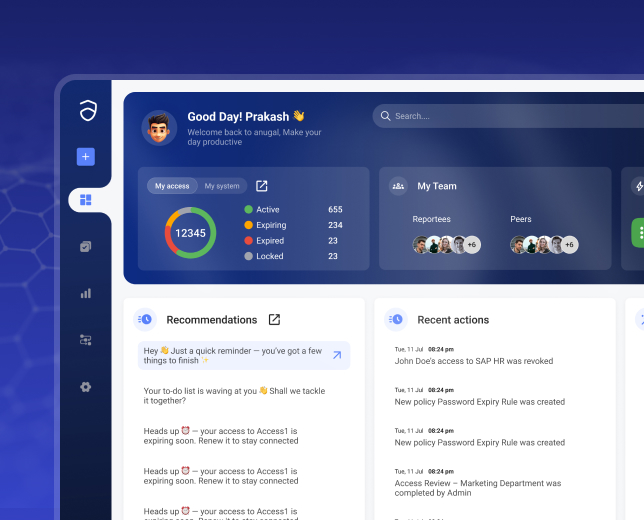
Manage Machine & Third-Party Access
Govern Non-Human and External Identities with the Same Control as Workforce Access
Anugal governs machine accounts, service identities, vendors, and contractors through policy-driven lifecycle controls, ensuring access is justified, time-bound, and continuously monitored.
The Reality of Non-Human & External Access
Modern enterprises no longer operate with employees alone. Service accounts power integrations. APIs connect platforms. Vendors administer infrastructure. Contractors support time-bound initiatives. Automation tools and scripts interact directly with production systems. These identities often exist outside traditional HR-driven lifecycle controls. They lack clear ownership, operate with persistent credentials, accumulate privileged access, and frequently fall outside periodic certification cycles. Creation is documented; ongoing governance is not.
While workforce access may follow structured policies, machine and third-party identities often remain loosely monitored—creating concentrated, invisible risk across critical systems. Effective governance must extend beyond human users to every digital actor operating within the enterprise environment.
Where Machine & Third-Party Access Breaks Down
Most enterprises encounter predictable control gaps:
No Defined Lifecycle
Service accounts and vendor identities lack structured onboarding and termination controls.Shared Credentials & Static Secrets
Access is reused, embedded in scripts, or left unchanged for years.Limited Ownership Visibility
Business accountability for external and machine identities is unclear.Privileged Access Exposure
Third parties often receive broad access to avoid operational delays.Certification Blind Spots
Non-human identities are excluded from access reviews or reviewed superficially.The Anugal Difference: Non-Human Identities as Governed Entities
Anugal treats machine and third-party access as governed identity objects not technical exceptions. Every external or service identity is assigned accountable ownership, evaluated against eligibility and risk policies, enforced with time-bound and purpose-based controls, included in certification and audit cycles. Access decisions follow the same governance discipline applied to employees.
What This Enables Across the Access Lifecycle
Controlled Onboarding of Third Parties
- Vendor and contractor access is time-bound and policy-evaluated before activation.
- Access scope aligns with contract, role, and system sensitivity.
Governed Machine Identity Management
- Service accounts are registered with ownership and purpose metadata.
- Privileged and high-risk access is continuously monitored.
Expiration & Renewal Controls
- Access automatically expires based on contract or defined lifecycle.
- Renewal requires explicit revalidation and approval.
Cross-System Enforcement
- Machine and vendor access spans ERP, cloud, operational, and legacy systems.
- Governance extends across environments—not just directories.
Audit-Ready Accountability
- Every non-human identity has traceable approval history.
- Decisions, policies, and enforcement outcomes are preserved for compliance review.

Why This Matters to the Business
- Reduced third-party breach exposure
- Elimination of unmanaged service accounts
- Stronger privileged access control
- Lower audit risk related to vendor access
- Clear accountability across all digital identities
Where This Fits in Your Governance Strategy
Accelerated access reviews strengthen:
Segregation of Duties enforcement
Privileged access management controls
Regulatory and contractual compliance
Zero Trust identity posture
Continuous risk monitoring
Enterprise-wide least privilege adherence