

Governance Controls for AI Agents Operating in Production Systems
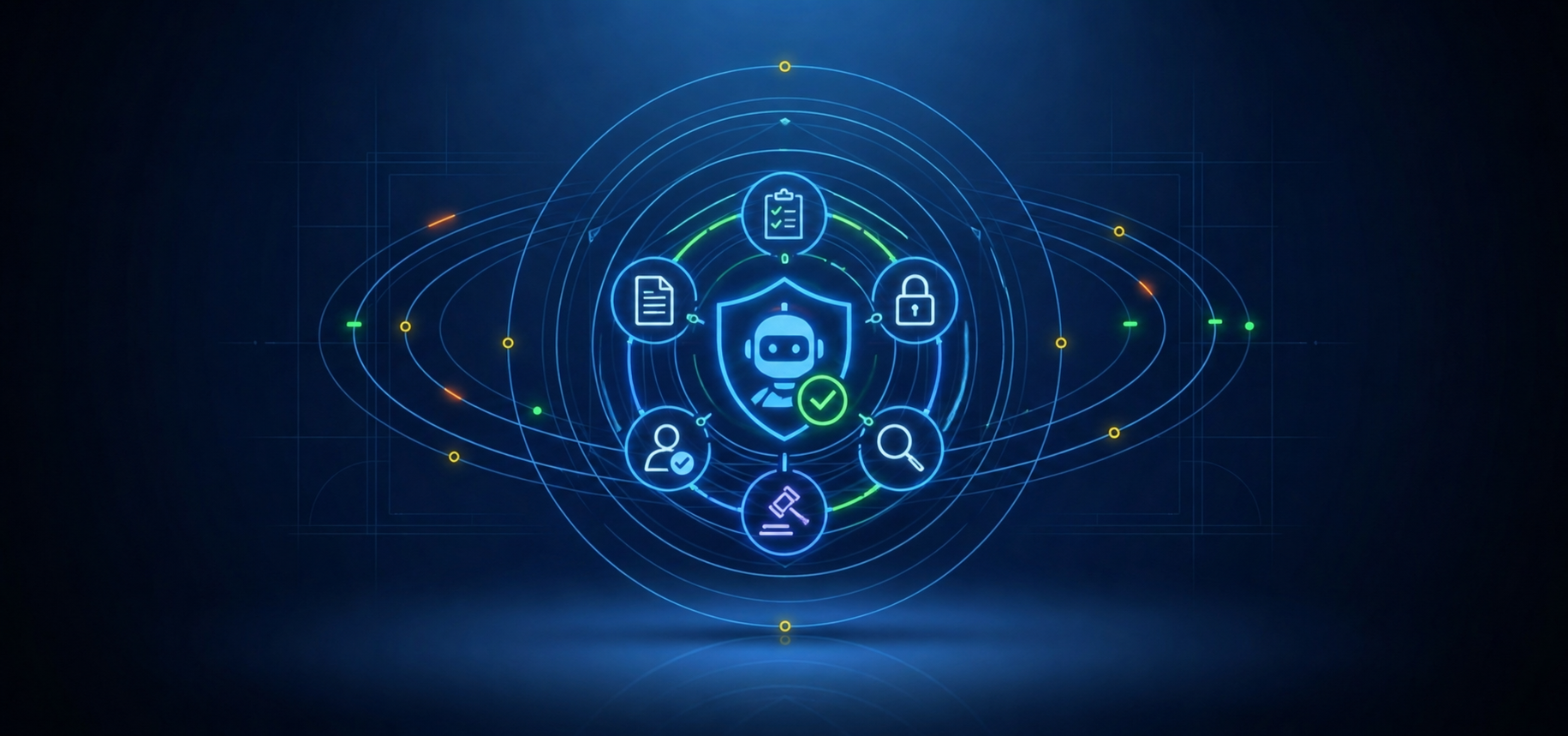
An AI agent posted a journal entry, provisioned access for a contractor, and closed a service desk ticket while you were reading the first sentence of this article. None of those actions waited for human review, and all of them will appear in your next audit. Production AI agents need six operational controls to make that audit defensible: a unique non-human identity, scoped least-privilege authorization, continuous certification, a reconstructable audit trail, time-bound emergency access, and behavioral monitoring with corrective execution.
Together they let IT and Security Operations teams audit, certify, and govern autonomous agents with the same rigor applied to privileged users.
Why AI agents need their own governance controls
78% of senior leaders cannot confidently say their organization would pass an independent AI governance audit within ninety days, according to the Grant Thornton 2026 AI Impact Survey. The number does not surprise anyone running production systems. AI agents are now provisioning access, posting transactions, and closing tickets across SAP, ServiceNow, and cloud platforms without a clear audit trail behind them. The traditional identity stack was built for humans, now agents change that picture in three ways.
- They act autonomously rather than waiting for a human to click.
- They operate at machine scale, with 82 non-human identities for every human identity already present in most enterprises.
- They make decisions that traditional IGA tools were never designed to certify.
And each of these shifts demands its own control.
The six controls every production AI agent needs
Each control answers a specific audit question. Each one produces evidence the certifier can review. Without all six in place, the auditor sees gaps and the security team carries the risk.
Control 1: Unique non-human identity for every agent
Every agent must operate under its own non-human identity, distinct from any human or shared service account. Actions performed by the agent must attribute to that identity in every connected system. Without unique identity, attribution breaks and the audit trail collapses into a generic automation log that no certifier can sign off on.
Control 2: Scoped, least-privilege authorization
Each agent identity must hold only the permissions required by its stated purpose. Authorization scopes must be documented, enforced at the system boundary, and reviewed when the agent's purpose changes. Segregation of Duties rules apply to agents the same way they apply to humans, and conflicting permissions must be blocked at request time rather than caught later in a review.
Control 3: Continuous access certification on a tighter cadence than human review
Annual or quarterly certification cycles fail for agents because their behavior, scope, and risk profile change far faster than a human role does. Certification must trigger on behavioral change, role drift, or scope expansion rather than on the calendar. The certifier needs to see what the agent actually did, not only what it was authorized to do.
Control 4: Decision and action audit trail with reconstruction capability
Every action the agent takes must be logged with enough context to reconstruct why it took the action six months later. Inputs, intermediate reasoning where available, tool invocations, and resulting state changes all belong in the trail. A trail that captures only the final action without the surrounding context is not an audit trail. It is a transaction log, and an auditor will treat it as such.
Control 5: Time-bound emergency access with automated review
Agents should not hold standing privileged access. Emergency or elevated access must be granted on a time-bound basis, with automatic expiration and a required post-use review of every action taken under the elevation. Standing privilege for an autonomous agent is the security pattern most likely to surface as a finding in an audit, and it is the easiest to remediate by design.
Control 6: Behavioral monitoring with corrective execution
Monitoring an agent for anomalies is necessary but not sufficient. Detection without correction leaves the security team in a permanent reactive posture. The control is a coordinated execution layer that detects deviation from expected behavior and triggers a corrective action automatically, whether that means revoking access, escalating to a human reviewer, or rolling back the change.
How to certify AI agent access without overwhelming the team
Manual certification of agent access does not scale to the pace of the current world as the number of identities is too high and the rate of behavioral change is too fast. AI-assisted certification is becoming the default approach by most enterprises as the platform pre-analyzes each entitlement, surfaces a recommended action with rationale, auto-certifies low-risk items, and routes only material risks to a human reviewer.
Today's certifier's job becomes review and judgment rather than data collection as evidence assembly happens automatically and audit-readiness is enforced even before the audit begins.
Mapping these controls to NIST AI RMF, ISO 42001, and the EU AI Act
The six controls align cleanly to the major AI governance frameworks. The mapping below shows the primary alignment for each control.
| Control | Primary framework alignment | Audit evidence produced |
|---|---|---|
| Unique non-human identity | NIST AI RMF GOVERN 1.4; ISO 42001 Clause 8 | Agent identity registry with attribution |
| Scoped least-privilege authorization | NIST AI RMF MANAGE 2.4; EU AI Act Article 14 | Authorization scope documents and SoD reports |
| Continuous certification | NIST AI RMF MEASURE 4; ISO 42001 Clause 9 | Certification history with reviewer rationale |
| Reconstructable audit trail | NIST AI RMF MANAGE 4.1; EU AI Act Article 12 | Decision and action logs with full context |
| Time-bound emergency access | NIST AI RMF MANAGE 2.4; ISO 42001 Clause 8 | Elevation tickets with post-use review |
| Behavioral monitoring with correction | NIST AI RMF MEASURE 2.7; EU AI Act Article 15 | Anomaly logs with corrective action records |
Source frameworks: NIST AI Risk Management Framework; ISO/IEC 42001; EU AI Act.
Where Anugal fits
Anugal operationalizes these six controls as a single orchestration layer rather than a collection of stand-alone tools. The platform issues unique identities to agents, enforces scoped authorization with an SoD engine, runs AI-assisted access certifications, generates reconstructable audit trails, manages time-bound emergency access, and pairs behavioral monitoring with coordinated corrective execution. Anugal reports 100% audit trail readiness, 100% visibility into access and risk, three-times faster provisioning, and 90% to 95% automated workflows across its production deployments.
From governance intent to audit-ready evidence
AI agents will keep acting in production whether the controls are in place or not. The question for IT and Security Operations leaders is whether the next audit will surface gaps or surface evidence. The six controls turn agentic AI from an audit risk into an audit asset. Each one is implementable today and each one produces the evidence a certifier needs.
To see how the six controls are implemented in a single orchestration layer, book a meeting with our experts!
Frequently Asked Questions
1. What controls do AI agents need in production?
AI agents acting in production need six operational controls: a unique non-human identity, scoped least-privilege authorization, continuous certification, a reconstructable audit trail, time-bound emergency access, and behavioral monitoring with corrective execution.
2. How do you audit AI agent access?
Every action the agent takes must be logged with enough context to reconstruct why it took the action six months later. Inputs, intermediate reasoning where available, tool invocations, and resulting state changes all belong in the audit trail.
3. How do you certify AI agent access?
AI-assisted certification is the default approach. The platform pre-analyzes each entitlement, surfaces a recommended action with rationale, auto-certifies low-risk items, and routes only material risks to a human reviewer.
4. Do AI agents need their own identity?
Yes. Every agent must operate under its own non-human identity, distinct from any human or shared service account, so actions can be attributed to that specific agent in every connected system.
5. How does AI agent governance map to NIST AI RMF and ISO 42001?
The six operational controls align to NIST AI RMF GOVERN, MEASURE, and MANAGE functions, ISO 42001 Clauses 8 and 9, and EU AI Act Articles 12, 14, and 15.