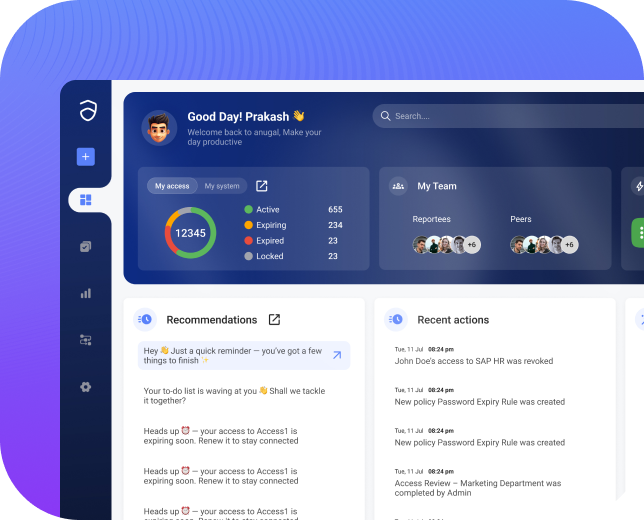


Agentic IGA Platform
Meet Agentic IGA: Agentic AI, Without Autonomy Risk
A new approach to identity governance built for dynamic, distributed, always-changing enterprises.
Why Identity Needs Agents, Not More Dashboards
Identity has become the largest attack surface in the enterprise. Every access change, role update, exception, and certification generates security signals but most of them are never analyzed in time. Traditional IGA platforms rely on periodic reviews and static workflows. Security teams are left reacting to audit findings instead of preventing identity-driven risk.
Anugal’s agentic IGA architecture introduces persistent, policy-bound AI agents that continuously analyze identity signals, surface risk, and drive governed action without bypassing human accountability.
The Cybersecurity Challenges
Enterprises Face Today
Identity Risk Grows Faster Than Humans Can Track
Thousands of access events occur daily across SaaS, ERP, cloud, and infrastructure systems. Manual analysis cannot keep pace.
Security Reviews Are Broad but Shallow
Certifications and reviews cover everything equally, leading to reviewer fatigue and missed high-risk access.
Privileged & Exception Access Drifts
Emergency access, SoD exceptions, and compensating controls are approved—but rarely monitored continuously.
AI Adoption Feels Risky
Security leaders want AI assistance, but cannot accept black-box decisions, policy overrides, or audit ambiguity.
Design Principles Behind
Anugal’s Agentic IGA
Policy-First by Design
AI agents operate strictly within defined governance rules, SoD policies, and approval models.
Human Accountability Preserved
Agents recommend, prioritize, and assist—final authority remains with accountable owners.
Explainable and Auditable
Every agent insight, recommendation, and action is traceable with full context.
Orchestration, Not Automation Chaos
Agents execute through existing workflows, not side channels or shadow logic.
How Anugal Simplifies Identity Security with Agents
Anugal embeds task-specific AI agents directly into identity governance workflows, where decisions already occur.
Agents continuously observe identity signals, correlate risk, and surface what matters most, while orchestration ensures actions remain governed, approved, and logged. This allows security teams to move from periodic governance to continuous identity control.
Agentic Use Cases That
Matter to Security Teams
Continuous Access Risk Detection
AI agents monitor access assignments and role combinations to flag emerging risk before audits or incidents.
Privileged & Exception Oversight
Approved exceptions and emergency access are tracked continuously, not forgotten after approval.
Smarter Certifications
High-risk users and entitlements are prioritized, reducing reviewer fatigue and improving review quality.
SoD Risk Awareness
Emerging or recurring SoD violations are highlighted early, before becoming control failures.
Dormant & Excess Access Control
Unused and overlapping access is identified proactively to reduce attack surface.
AI Adoption Without Losing Governance
Anugal’s agentic architecture supports multiple operating modes:
Advisory Mode
AI generates context-aware recommendations based on access history, risk posture, role mappings, and policy rule`s.
Assisted Mode
AI pre-validates requests against SoD policies, risk libraries, and entitlement models.
Controlled Automation Mode
Pre-approved policies govern automated actions such as provisioning, deprovisioning, certification enforcement, or risk remediation.
AI Adoption Without Losing Governance
Anugal’s agentic architecture supports multiple operating modes:
- Advisory – recommendations only
- Assisted – one-click execution with approval
- Controlled automation – policy-approved actions with evidence
Built for Cyber
Accountability Reality
Works across SaaS, ERP, cloud, and infrastructure identities
Adapts to enterprise-specific risk models and regulations
Scales identity governance without scaling headcount
Produces audit-ready evidence by default